
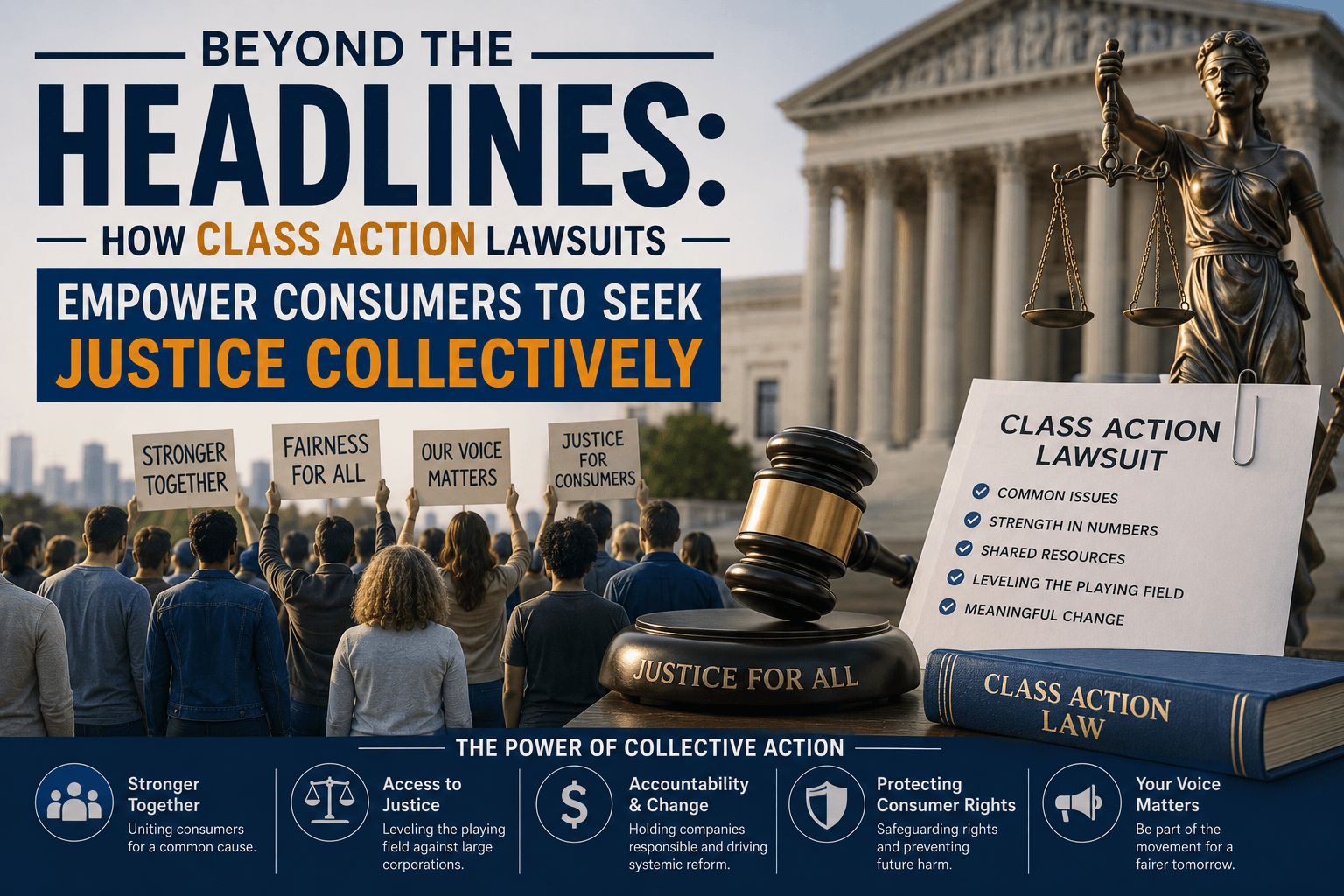

When news headlines announce a major class action lawsuit against a multinational corporation, financial institution, pharmaceutical company, or technology platform, the stories often focus on large settlement amounts or the number of people involved. While these headlines capture attention, they rarely explain why class action lawsuits exist or why they have become one of the most influential legal tools available to consumers.
For many individuals, pursuing legal action independently is simply not practical. The financial loss may be relatively small, legal costs may appear overwhelming, or the complexity of the dispute may discourage someone from filing a lawsuit altogether. As a result, organizations responsible for widespread but individually modest harm might never be held accountable if each affected person had to pursue justice alone.
Class action lawsuits address this challenge by allowing multiple individuals with similar legal claims to combine their cases into a single legal action. Instead of hundreds or thousands of nearly identical lawsuits proceeding separately, one representative case can move forward on behalf of an entire group.
More than just a procedural mechanism, class action litigation has become an important part of modern consumer protection. It provides individuals with access to justice while encouraging organizations to maintain responsible business practices and comply with legal obligations.
This article explores how class action lawsuits work from a broader perspective, why they play an essential role in protecting consumers, and the impact they have on businesses, industries, and society as a whole.
Understanding the Purpose of Class Action Lawsuits
At its core, a class action lawsuit is designed to resolve disputes involving numerous people who have experienced similar harm arising from the same conduct.
Rather than requiring every individual to file a separate lawsuit, the legal system allows one or more representative plaintiffs to pursue claims on behalf of everyone who qualifies as a member of the class.
This approach offers several practical advantages:
- Greater efficiency
- Reduced legal costs
- Consistent court decisions
- Improved access to justice
- Stronger collective representation
Without this legal framework, many legitimate claims might never be pursued because the cost of individual litigation could exceed the value of the damages suffered.
Why Individual Lawsuits Are Not Always Practical
Imagine a company mistakenly charges one million customers an additional $25.
For any single customer, spending months pursuing legal action over such a relatively small amount would likely make little financial sense.
However, when those same claims are combined, the total alleged harm reaches millions of dollars.
Class action lawsuits allow these smaller individual claims to be addressed collectively, making legal action economically feasible while providing an opportunity for affected consumers to seek compensation.
This concept helps explain why class actions frequently involve:
- Consumer products
- Banking fees
- Data breaches
- Employment practices
- Defective products
- Pharmaceutical medications
- Environmental incidents
In many of these situations, individual losses may appear modest while the overall impact becomes substantial when viewed collectively.
Leveling the Playing Field
Large corporations often possess significant financial resources, legal teams, and extensive experience handling litigation.
Individual consumers typically do not.
This imbalance can discourage people from asserting their legal rights, especially when confronting well-funded organizations.
Class action lawsuits help reduce that imbalance by allowing individuals to combine their resources and present a unified legal claim.
Instead of facing legal challenges alone, affected individuals become part of a larger collective effort that may have greater access to experienced legal representation and investigative resources.
This collective approach promotes fairness within the legal system by ensuring that financial disparities do not automatically determine who can pursue justice.
Holding Organizations Accountable
Beyond financial compensation, class action lawsuits often encourage organizations to examine and improve their business practices.
Companies may reevaluate:
- Product safety procedures
- Consumer disclosures
- Data security measures
- Employment policies
- Marketing practices
- Compliance programs
In some cases, settlements or court orders require organizations to implement operational changes designed to reduce the likelihood of similar problems occurring in the future.
As a result, the impact of a class action lawsuit may extend well beyond the individuals directly involved.
Encouraging Corporate Responsibility
Modern businesses operate in increasingly complex environments.
They manage customer information, manufacture products, deliver financial services, develop technology, and provide healthcare solutions to millions of people.
With this scale comes responsibility.
Class action litigation can encourage organizations to:
- Strengthen quality control
- Improve internal oversight
- Increase transparency
- Enhance consumer protections
- Address safety concerns more quickly
While lawsuits are not the only mechanism promoting accountability, they represent one important component of broader consumer protection systems.
Expanding Access to Justice
Access to justice is often discussed as a fundamental principle of a fair legal system.
However, practical barriers can make legal action difficult for many individuals.
Common obstacles include:
- High litigation costs
- Limited legal knowledge
- Time commitments
- Fear of confronting large organizations
- Uncertainty regarding potential outcomes
Class action lawsuits help reduce several of these barriers by allowing legal costs and resources to be shared across a larger group of affected individuals.
This collective structure enables claims that might otherwise remain unresolved.
Promoting Judicial Efficiency
Court systems benefit when similar legal disputes are handled together rather than through hundreds of separate proceedings.
Instead of hearing identical evidence repeatedly, courts can evaluate common issues within a single coordinated case.
This approach may:
- Reduce duplicate litigation
- Improve consistency
- Conserve judicial resources
- Simplify case management
While class actions can themselves become complex, they often provide a more efficient alternative to numerous individual lawsuits involving the same underlying facts.
The Types of Cases Commonly Resolved Through Class Actions
Class action lawsuits arise in many different industries.
Some of the most common examples include:
Consumer Protection
Consumers may allege deceptive advertising, hidden fees, false product claims, or unfair business practices affecting large groups of people.
Product Liability
Defective consumer products may result in widespread injuries or financial losses that affect numerous purchasers.
Data Privacy
Organizations experiencing cybersecurity incidents or improper data handling may face claims involving large numbers of affected individuals.
Employment Practices
Employees sometimes pursue collective claims involving wage disputes, overtime issues, workplace policies, or discrimination allegations.
Environmental Incidents
Communities affected by pollution, hazardous substances, or environmental contamination may seek collective legal remedies when multiple individuals experience similar harm.
Although these cases differ significantly, they share one important characteristic: many people are affected by substantially similar conduct.
More Than Financial Compensation
Public discussion often focuses on settlement amounts, but financial recovery represents only one aspect of many class action lawsuits.
Depending on the circumstances, litigation may also lead to:
- Policy revisions
- Product recalls
- Improved safety standards
- Better consumer disclosures
- Enhanced regulatory compliance
- Increased public awareness
These broader outcomes can influence industries long after a particular lawsuit concludes.
In this sense, class action litigation often serves both private and public interests by encouraging greater accountability and transparency.
The Role of Representative Plaintiffs
Every class action lawsuit begins with one or more individuals who step forward to represent a larger group of people with similar claims. These individuals are often referred to as representative plaintiffs or class representatives.
Their role extends beyond pursuing their own claims. They work with legal counsel throughout the litigation process while helping present issues that affect the broader class.
Although representative plaintiffs play an important role, major decisions in class action litigation are generally subject to court oversight. This helps ensure that any proposed resolution considers the interests of all eligible class members rather than only those directly involved in filing the lawsuit.
How Class Action Lawsuits Strengthen Consumer Confidence
Markets function best when consumers have confidence that businesses will operate fairly and responsibly.
When organizations know they may be held accountable for widespread misconduct, they often have stronger incentives to:
- Improve product quality
- Strengthen customer service
- Invest in compliance programs
- Respond quickly to safety concerns
- Address consumer complaints before they escalate
Consumers also benefit from knowing that legal remedies may be available if widespread problems occur.
Although class action lawsuits cannot prevent every dispute, they contribute to an environment where accountability and transparency are encouraged.
Common Misconceptions About Class Action Lawsuits
Because class actions frequently receive media attention, several misconceptions have developed over time.
Myth 1: Class Actions Only Benefit Lawyers
Legal representation is an essential part of any complex litigation, but class action lawsuits can also provide meaningful benefits to consumers.
Depending on the circumstances, outcomes may include:
- Financial compensation
- Product replacements
- Service improvements
- Policy changes
- Enhanced consumer protections
Many settlements also require court approval, adding another layer of oversight to help ensure fairness.
Myth 2: Every Large Company Is Constantly Facing Class Actions
The existence of a large customer base does not automatically lead to class action litigation.
For a case to proceed as a class action, it generally must involve common legal or factual issues affecting a defined group of individuals.
Many disputes remain individual matters because they do not meet these requirements.
Myth 3: Every Class Member Receives a Large Payment
Settlement amounts vary considerably.
The amount an individual may receive depends on factors such as:
- The nature of the claim
- The number of eligible participants
- Documented losses
- Settlement terms
- Court approval
Some settlements prioritize business practice changes or consumer protections alongside financial compensation.
Challenges Associated With Class Action Litigation
While class actions provide important benefits, they are not without challenges.
Complex cases often require:
- Extensive document review
- Expert analysis
- Multiple court hearings
- Significant investigation
- Long litigation timelines
Because many people may be affected, courts carefully review procedural requirements before allowing cases to move forward.
This process helps protect both plaintiffs and defendants while ensuring that class treatment is appropriate.
Why Not Every Dispute Becomes a Class Action
Many people assume that whenever numerous individuals experience similar problems, a class action automatically follows.
In reality, several factors influence whether a dispute is suitable for collective litigation.
These may include:
- Similarity of claims
- Common legal questions
- Size of the affected group
- Practicality of individual lawsuits
- Court certification requirements
Some disputes are better resolved through individual claims because each person’s circumstances differ significantly.
The legal system evaluates these issues carefully before determining the appropriate path.
The Importance of Court Oversight
Unlike many private legal disputes, class action lawsuits typically involve ongoing judicial supervision.
Courts may review issues such as:
- Whether class certification requirements have been satisfied
- Whether proposed settlements are fair
- How class members will be notified
- How settlement funds will be distributed
- Whether legal procedures protect the interests of the class
This oversight promotes transparency and helps maintain confidence in the legal process.
The Growing Influence of Technology
Technology is reshaping both the types of disputes that lead to class actions and the way those cases are managed.
Today’s litigation increasingly involves issues such as:
- Data privacy
- Cybersecurity breaches
- Artificial intelligence
- Digital subscriptions
- Online marketplaces
- Mobile applications
At the same time, technology has improved case administration by making it easier to distribute notices, process claims, and communicate with class members.
As digital commerce continues to expand, technology-related class actions are likely to become even more common.
The Broader Impact on Society
The effects of class action lawsuits often extend well beyond the courtroom.
Successful litigation may encourage:
- Safer consumer products
- Greater corporate transparency
- Improved regulatory compliance
- Better risk management
- Increased public awareness of consumer rights
Businesses frequently review internal practices following major lawsuits, even when they are not directly involved in the litigation.
In this way, class actions can influence industry standards and encourage continuous improvement.
Looking Ahead
As industries evolve, so do the legal issues affecting consumers.
Emerging technologies, global commerce, digital services, and increasingly complex products continue to create new legal challenges.
Class action lawsuits will likely remain an important mechanism for addressing situations in which large groups of people experience similar harm.
At the same time, courts, businesses, and policymakers will continue refining procedures to balance efficiency, fairness, and due process.
The legal landscape will undoubtedly change, but the underlying principle behind class actions—providing an efficient way for people to pursue collective justice—is expected to remain highly relevant.
Conclusion
Class action lawsuits are about far more than the headline-making settlements often featured in the news. They represent an important legal mechanism that allows individuals with similar claims to pursue justice collectively when individual lawsuits may be impractical or financially unrealistic.
By bringing together people affected by the same conduct, class actions promote efficiency, improve access to justice, and encourage organizations to operate responsibly. Their impact often extends beyond financial compensation, leading to policy changes, stronger consumer protections, improved safety standards, and greater corporate accountability.
While every dispute is unique, the broader role of class action litigation remains consistent: creating opportunities for consumers to seek meaningful remedies while reinforcing the principle that no organization is beyond accountability.
As business practices, technology, and consumer expectations continue to evolve, class action lawsuits will likely remain an essential part of modern legal systems and consumer protection efforts.
Frequently Asked Questions
What is the primary purpose of a class action lawsuit?
A class action lawsuit allows multiple people with similar legal claims to pursue a single collective case, improving efficiency and access to justice.
Why are class action lawsuits important for consumers?
They enable consumers to seek remedies when individual claims may be too costly or impractical to pursue independently while encouraging responsible business practices.
Do all class members need to file separate lawsuits?
No. In many class actions, eligible individuals are represented collectively through representative plaintiffs, subject to applicable legal procedures and court approval.
Are class action lawsuits only about financial compensation?
No. Some cases also result in product improvements, policy changes, enhanced consumer disclosures, stronger safety measures, or other forms of non-monetary relief.
Can class action lawsuits influence industries beyond the companies involved?
Yes. Significant class actions often encourage broader improvements in compliance, transparency, consumer protection, and corporate governance across entire industries.