
Accidents are not always caused entirely by one person. In many situations, multiple individuals or organizations may contribute to the events leading to an injury. A driver may have been speeding while another driver failed to yield, or a property owner may have overlooked a hazard while a visitor ignored warning signs. These situations raise important legal questions about how responsibility should be divided and how compensation should be determined.
Comparative negligence is a legal principle used in many jurisdictions to allocate responsibility when more than one party shares fault for an accident. Rather than treating fault as an all-or-nothing issue, comparative negligence recognizes that responsibility can be divided among multiple parties based on their respective actions.
Understanding how comparative negligence works helps individuals better appreciate how personal injury claims are evaluated and why evidence plays such an important role in determining liability and compensation.
What Is Comparative Negligence?
Comparative negligence is a legal doctrine that allows fault for an accident to be shared among the parties involved.
Instead of asking whether only one person was responsible, courts or insurance companies may evaluate:
- Each party’s actions
- Whether reasonable care was exercised
- The degree of responsibility assigned to each person
- How those fault percentages affect recoverable damages
The specific rules vary depending on the laws of the jurisdiction where the claim is brought.
Why Comparative Negligence Exists
Many accidents involve a combination of circumstances rather than a single mistake.
Comparative negligence helps the legal system:
- Recognize shared responsibility
- Promote fairness
- Encourage personal accountability
- Reflect the facts of each individual case
- Provide a structured method for allocating damages
Rather than placing all responsibility on one individual, comparative negligence allows fault to be distributed according to the available evidence.
Pure Comparative Negligence
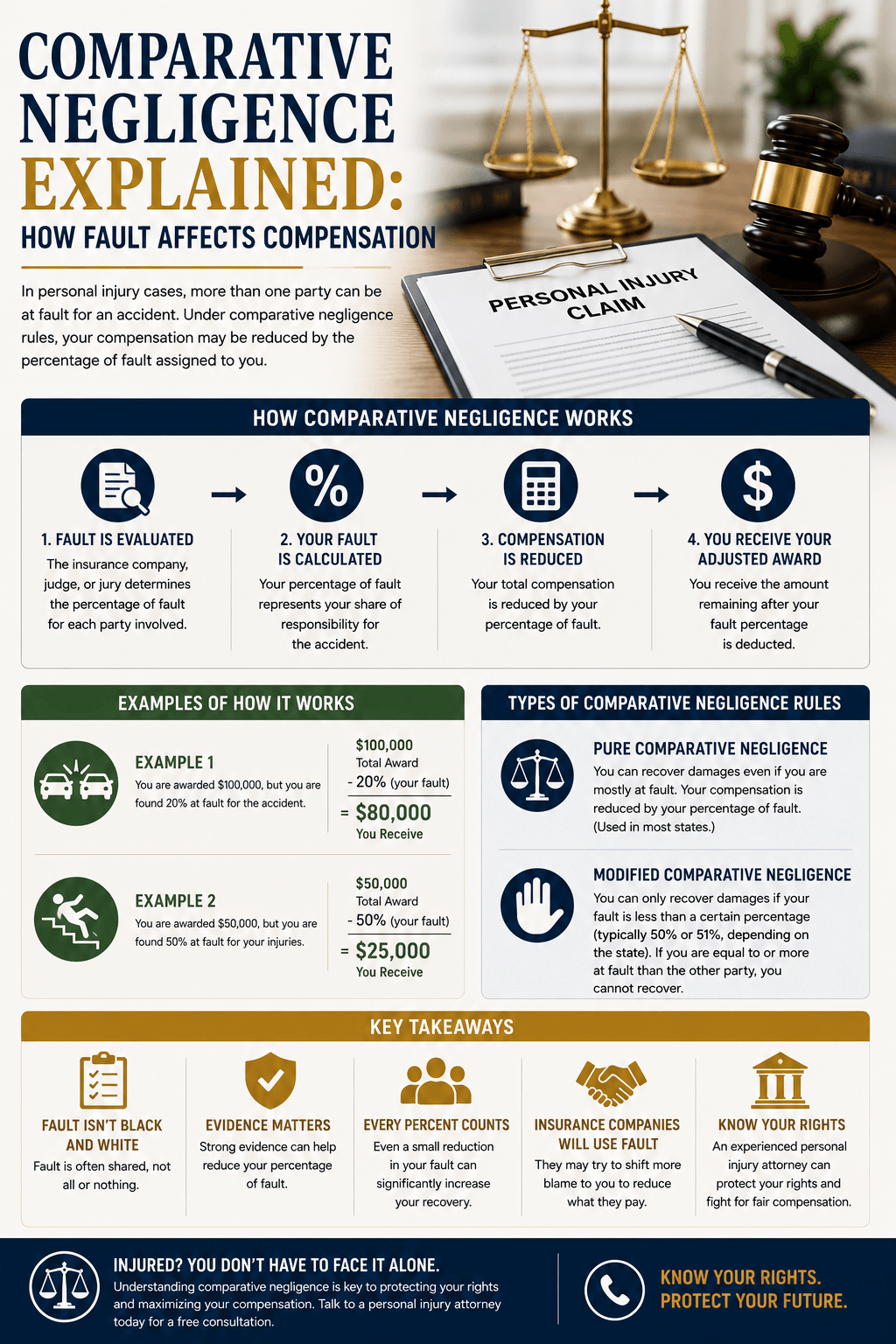
Under a pure comparative negligence system, an injured person’s compensation may be reduced by their percentage of fault.
For example:
- Total damages: $100,000
- Plaintiff’s fault: 20%
- Potential recoverable damages: $80,000
Even if an injured party is found largely responsible for an accident, some jurisdictions still allow recovery after reducing compensation by the assigned percentage of fault.
The availability of this approach depends entirely on the applicable law.
Modified Comparative Negligence
Many jurisdictions use a modified comparative negligence system.
Under this approach, recovery may only be available if the injured person’s share of fault does not exceed a specified legal threshold.
Common thresholds include:
- 50%
- 51%
The exact rule varies by jurisdiction.
Modified comparative negligence seeks to balance compensation with personal responsibility while limiting recovery when an individual’s own negligence exceeds the applicable legal standard.
Comparative Negligence vs. Contributory Negligence
Comparative negligence is sometimes confused with contributory negligence.
Although both involve shared fault, they operate differently.
Comparative Negligence
- Allows fault to be divided.
- Compensation may be adjusted according to each party’s responsibility.
- Used in many jurisdictions.
Contributory Negligence
- Exists in only a small number of jurisdictions.
- Even minimal fault by the injured party may significantly affect or prevent recovery, depending on applicable law.
Because legal standards differ considerably, understanding the governing rules in the relevant jurisdiction is important.
Common Situations Where Comparative Negligence May Apply
Comparative negligence may arise in many types of personal injury cases.
Motor Vehicle Accidents
Examples include situations where:
- One driver was speeding.
- Another driver failed to yield.
- Both drivers violated traffic laws.
- Distracted driving contributed to the collision.
- Poor weather affected visibility.
Investigators evaluate the actions of everyone involved when determining fault.
Slip and Fall Incidents
Shared fault may become an issue if:
- A property owner failed to repair a hazardous condition.
- Warning signs were present.
- The injured person ignored obvious hazards.
- Lighting conditions affected visibility.
Each situation is evaluated based on its own facts.
Bicycle and Pedestrian Accidents
Potential considerations include:
- Crosswalk use
- Traffic signals
- Vehicle speed
- Road conditions
- Visibility
- Compliance with traffic laws
Responsibility may be shared depending on the evidence.
Product Liability Cases
Although many product liability cases focus on alleged defects, comparative negligence may sometimes become relevant if questions arise regarding product misuse or failure to follow provided safety instructions.
How Fault Is Determined
Determining comparative negligence requires careful examination of available evidence.
Common sources include:
- Police reports
- Medical records
- Witness statements
- Surveillance footage
- Dash camera recordings
- Photographs
- Accident reconstruction reports
- Expert testimony
- Physical evidence
Insurance companies, attorneys, judges, and juries may evaluate this information when determining fault percentages.
The Role of Evidence
Strong evidence helps establish how an accident occurred.
Useful documentation may include:
- Accident scene photographs
- Vehicle damage
- Medical evaluations
- Weather reports
- Maintenance records
- Cell phone records where legally available
- Inspection reports
- Expert analyses
Comprehensive evidence often provides a clearer understanding of each party’s actions.
Insurance and Comparative Negligence
Insurance companies frequently evaluate comparative negligence during claim investigations.
Adjusters may review:
- Accident reports
- Statements from those involved
- Vehicle inspections
- Medical documentation
- Witness interviews
- Applicable traffic laws
Because insurers and claimants may interpret evidence differently, fault allocation can become an important part of settlement discussions.
Why Comparative Negligence Matters
Comparative negligence influences both liability and potential compensation.
It encourages:
- Fair evaluation of evidence
- Individual accountability
- Careful accident investigation
- Objective assessment of responsibility
The doctrine recognizes that accidents often result from multiple contributing factors rather than a single cause.
Common Misconceptions About Comparative Negligence
Myth: If You Share Any Fault, You Cannot Recover Compensation
Many jurisdictions follow comparative negligence systems that may allow recovery even when an injured person shares some responsibility, although compensation may be reduced according to applicable law.
Myth: Fault Is Always Split Equally
Fault is not automatically divided equally between the parties. Responsibility is generally assigned according to the facts and evidence of each case.
Myth: Insurance Companies Always Decide Fault Correctly
Insurance companies conduct investigations, but fault determinations may be disputed and evaluated through negotiation, mediation, arbitration, or court proceedings depending on the circumstances.
Myth: Comparative Negligence Only Applies to Car Accidents
Comparative negligence may arise in many different personal injury cases, including premises liability, bicycle accidents, pedestrian accidents, workplace incidents involving third parties, and certain product liability claims.
The Future of Comparative Negligence
Technology continues influencing how fault is evaluated.
Emerging developments include:
- Artificial intelligence-assisted accident analysis
- Vehicle telematics
- Dash camera evidence
- Smart traffic systems
- Wearable health devices
- Digital accident reconstruction
- Drone scene documentation
- Advanced forensic software
These technologies may improve the accuracy of accident investigations and support more informed evaluations of comparative fault.
Practical Tips After an Accident
While every situation is different, individuals involved in an accident can often benefit from taking reasonable steps to preserve important information.
Helpful actions may include:
- Seeking appropriate medical attention.
- Reporting the accident to the relevant authorities when required.
- Taking photographs of the scene if it is safe to do so.
- Collecting contact information from witnesses.
- Keeping copies of medical records and repair estimates.
- Avoiding speculation about fault until the facts are fully evaluated.
Proper documentation may assist in understanding how an accident occurred and support any future insurance or legal processes.
Conclusion
Comparative negligence recognizes that responsibility for an accident is not always limited to one individual. By allowing fault to be allocated among multiple parties, this legal doctrine promotes a more balanced approach to evaluating liability and determining compensation.
Whether a case involves a motor vehicle collision, slip and fall, product-related incident, or another type of personal injury claim, the outcome often depends on the available evidence and the comparative negligence rules that apply in the relevant jurisdiction. Understanding these principles helps individuals appreciate the importance of careful investigation, thorough documentation, and objective evaluation when resolving personal injury disputes.
Frequently Asked Questions
What is comparative negligence?
Comparative negligence is a legal doctrine that allocates fault among multiple parties involved in an accident and may adjust compensation based on each party’s percentage of responsibility.
What is the difference between pure and modified comparative negligence?
Pure comparative negligence generally allows recovery after reducing compensation according to the injured person’s share of fault, while modified comparative negligence limits recovery if fault reaches a specified legal threshold.
Is comparative negligence the same as contributory negligence?
No. Comparative negligence allows fault to be shared, while contributory negligence follows different legal rules that may significantly affect recovery in certain jurisdictions.
How is fault determined in comparative negligence cases?
Fault is typically evaluated using evidence such as accident reports, witness statements, medical records, photographs, expert opinions, surveillance footage, and other relevant documentation.
Does comparative negligence apply only to car accidents?
No. Comparative negligence may apply in many types of personal injury cases, including slip and fall accidents, bicycle accidents, pedestrian incidents, certain product liability cases, and other negligence claims.