
Every personal injury case tells a story about how an accident occurred, who may have been responsible, and how an injury affected someone’s life. While personal accounts are important, successful personal injury claims are typically supported by objective evidence rather than assumptions or opinions. Whether a case involves a motor vehicle accident, slip and fall, defective product, workplace incident, or another type of injury, evidence provides the factual foundation that helps insurance companies, attorneys, judges, and juries evaluate what happened.
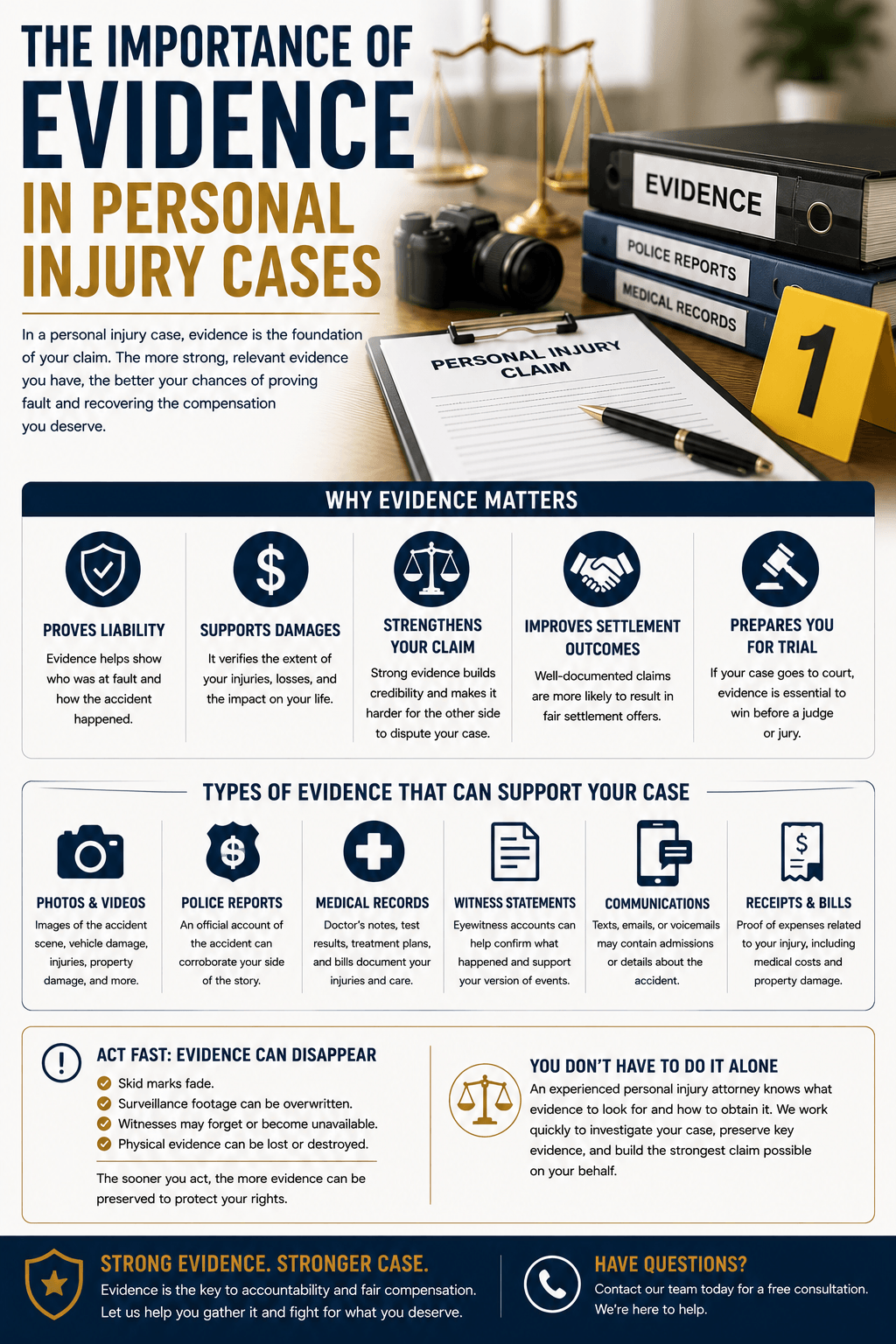
Evidence plays a central role in every stage of a personal injury claim. It helps establish liability, documents injuries, demonstrates financial losses, and supports the assessment of damages. Strong documentation can also reduce disputes, clarify conflicting accounts, and improve the accuracy of accident investigations.
Understanding the different types of evidence used in personal injury cases helps individuals appreciate why collecting and preserving information after an accident is often one of the most important steps in the claims process.
What Is Evidence in a Personal Injury Case?
Evidence is any information that helps establish facts relevant to a legal claim.
In personal injury cases, evidence may be used to demonstrate:
- How an accident occurred
- Who may have been responsible
- The extent of injuries
- Financial losses
- Medical treatment received
- Long-term effects of an injury
The quality, reliability, and relevance of evidence often influence how a claim is evaluated.
Why Evidence Is Important
Evidence helps transform allegations into verifiable facts.
It serves several important purposes, including:
- Supporting claims of negligence
- Documenting injuries
- Establishing liability
- Demonstrating financial losses
- Confirming timelines
- Resolving factual disputes
- Assisting expert evaluations
- Supporting settlement negotiations
Without sufficient evidence, it may be difficult to establish the necessary elements of a personal injury claim.
Medical Records
Medical records are among the most important forms of evidence in personal injury cases.
These records may include:
- Emergency room reports
- Hospital records
- Physician notes
- Diagnostic imaging
- Laboratory results
- Surgical reports
- Physical therapy records
- Prescription information
Medical documentation helps establish the nature of injuries, treatment provided, and the progression of recovery.
Photographs and Videos
Visual evidence often provides valuable information that may be difficult to describe through words alone.
Photographs may document:
- Accident scenes
- Vehicle damage
- Hazardous conditions
- Property damage
- Visible injuries
- Road conditions
- Weather conditions
Video recordings from surveillance systems, dashboard cameras, or nearby businesses may also assist in reconstructing how an accident occurred.
Witness Statements
Individuals who observed an accident may provide valuable information regarding the events leading up to the incident.
Witness statements may help clarify:
- The sequence of events
- Weather conditions
- Traffic conditions
- Safety hazards
- Actions of the parties involved
Independent witnesses often provide perspectives that supplement other available evidence.
Police and Incident Reports
Many accidents result in official reports prepared by law enforcement officers or other authorities.
These reports may contain:
- Date and time of the incident
- Location
- Names of involved parties
- Preliminary observations
- Diagrams
- Witness information
- Environmental conditions
Although official reports may not determine legal liability, they often become an important part of the investigative process.
Physical Evidence
Physical evidence includes tangible objects connected to the accident.
Examples include:
- Damaged vehicles
- Broken equipment
- Defective products
- Torn clothing
- Safety devices
- Product packaging
- Mechanical components
Proper preservation of physical evidence may assist experts in determining how an accident occurred.
Expert Testimony
Some personal injury cases involve technical or scientific issues that require specialized knowledge.
Experts may include:
- Medical professionals
- Engineers
- Accident reconstruction specialists
- Economists
- Occupational therapists
- Vocational experts
- Product safety specialists
Expert opinions help explain complex evidence in a way that decision-makers can better understand.
Financial Documentation
Evidence of financial losses is often essential when evaluating damages.
Important records may include:
- Medical bills
- Pharmacy receipts
- Rehabilitation expenses
- Repair estimates
- Employment records
- Tax returns
- Pay stubs
- Travel expenses related to medical treatment
These documents help establish measurable economic losses resulting from an injury.
Digital Evidence
Modern technology has introduced new forms of evidence that may become relevant in personal injury cases.
Examples include:
- Dashboard camera footage
- Security camera recordings
- GPS data
- Mobile phone photographs
- Vehicle telematics
- Smart device data
- Electronic medical records
Digital evidence often provides objective information regarding timelines and events.
Preserving Evidence After an Accident
Preserving evidence as early as possible helps reduce the risk of losing important information.
Helpful steps may include:
- Taking photographs of the accident scene.
- Seeking prompt medical evaluation.
- Keeping damaged property when appropriate.
- Saving receipts and invoices.
- Obtaining witness contact information.
- Reporting the incident to the appropriate authority.
- Maintaining copies of medical records.
Timely documentation often strengthens the overall accuracy of the evidence available.
Challenges in Gathering Evidence
Evidence collection is not always straightforward.
Common challenges include:
- Fading memories
- Lost documents
- Damaged physical evidence
- Weather changes
- Altered accident scenes
- Missing surveillance footage
- Incomplete records
Prompt investigation can help preserve important information before it becomes unavailable.
How Insurance Companies Evaluate Evidence
Insurance companies typically review available evidence when investigating personal injury claims.
This evaluation may include:
- Medical documentation
- Police reports
- Witness statements
- Photographs
- Repair estimates
- Expert reports
- Applicable insurance policies
The strength and consistency of the evidence often influence settlement discussions and claim evaluations.
Common Misconceptions About Evidence
Myth: A Personal Statement Is Enough
Personal accounts are important, but objective evidence such as medical records, photographs, and witness statements often provides stronger support for a claim.
Myth: Only Physical Injuries Require Documentation
Emotional distress, psychological injuries, lost income, and future medical needs may also require documentation to support a claim.
Myth: Evidence Can Be Collected at Any Time
Some forms of evidence, such as surveillance footage or accident scene conditions, may disappear quickly if not preserved promptly.
Myth: Every Piece of Evidence Has Equal Value
Different types of evidence carry varying levels of reliability and relevance depending on the facts of the case and applicable legal standards.
Technology and the Future of Evidence Collection
Technology continues transforming how evidence is gathered and analyzed.
Emerging developments include:
- Artificial intelligence-assisted document review
- Drone accident scene photography
- Three-dimensional accident reconstruction
- Wearable health devices
- Vehicle event data recorders
- Smart surveillance systems
- Cloud-based evidence management
- Advanced forensic imaging
These innovations may improve the accuracy, efficiency, and accessibility of evidence in future personal injury cases.
Best Practices for Documenting an Injury
Following an accident, maintaining organized records can help preserve important information.
Recommended practices include:
- Keep all medical appointments and records.
- Save receipts related to treatment and recovery.
- Maintain copies of correspondence with insurance companies.
- Photograph injuries as they heal.
- Record important dates and events.
- Store documents in a secure location.
- Keep repair estimates and invoices.
Well-organized documentation supports a clearer understanding of how an injury has affected daily life and financial circumstances.
Conclusion
Evidence is the foundation of every personal injury case. From medical records and photographs to witness statements, financial documentation, and expert opinions, each piece of evidence contributes to understanding how an accident occurred and what impact it had on the injured person.
Strong evidence not only helps establish liability and damages but also promotes fair claim evaluations and informed legal decision-making. As technology continues to improve accident investigations and documentation methods, preserving accurate and timely evidence remains one of the most important steps anyone can take after an injury.
Frequently Asked Questions
Why is evidence important in a personal injury case?
Evidence helps establish how an accident occurred, demonstrates the extent of injuries, documents financial losses, and supports the evaluation of liability and damages.
What types of evidence are commonly used in personal injury claims?
Common evidence includes medical records, photographs, videos, witness statements, police reports, financial documents, physical evidence, and expert opinions.
Can photographs help prove a personal injury claim?
Yes. Photographs can document accident scenes, injuries, property damage, hazardous conditions, and other important details that may assist in understanding how an incident occurred.
What should someone do to preserve evidence after an accident?
Seeking medical attention, taking photographs, saving receipts, obtaining witness information, reporting the incident, and keeping organized records can all help preserve valuable evidence.
Does digital evidence play a role in modern personal injury cases?
Yes. Dash camera footage, surveillance videos, GPS data, electronic medical records, and other digital information are increasingly important sources of evidence in personal injury investigations.