
Most car accident claims never see the inside of a courtroom. In many cases, insurers and claimants reach a settlement agreement that resolves the matter without litigation. Yet while some claims conclude within a few weeks or months, others evolve into lengthy disputes that eventually require legal intervention.
At first glance, the difference may appear to come down to money alone. However, settlement decisions are often influenced by a combination of legal, financial, strategic, and psychological factors. Human behavior, risk perception, communication styles, emotions, and expectations all play a role in determining whether a claim settles or proceeds toward litigation.
Understanding the psychology behind settlement decisions can help accident victims better understand why negotiations sometimes move smoothly and why other cases become increasingly complex.
This article explores the factors that influence settlement outcomes and examines why similar-looking claims can take dramatically different paths toward resolution.
Why Most Car Accident Claims Settle
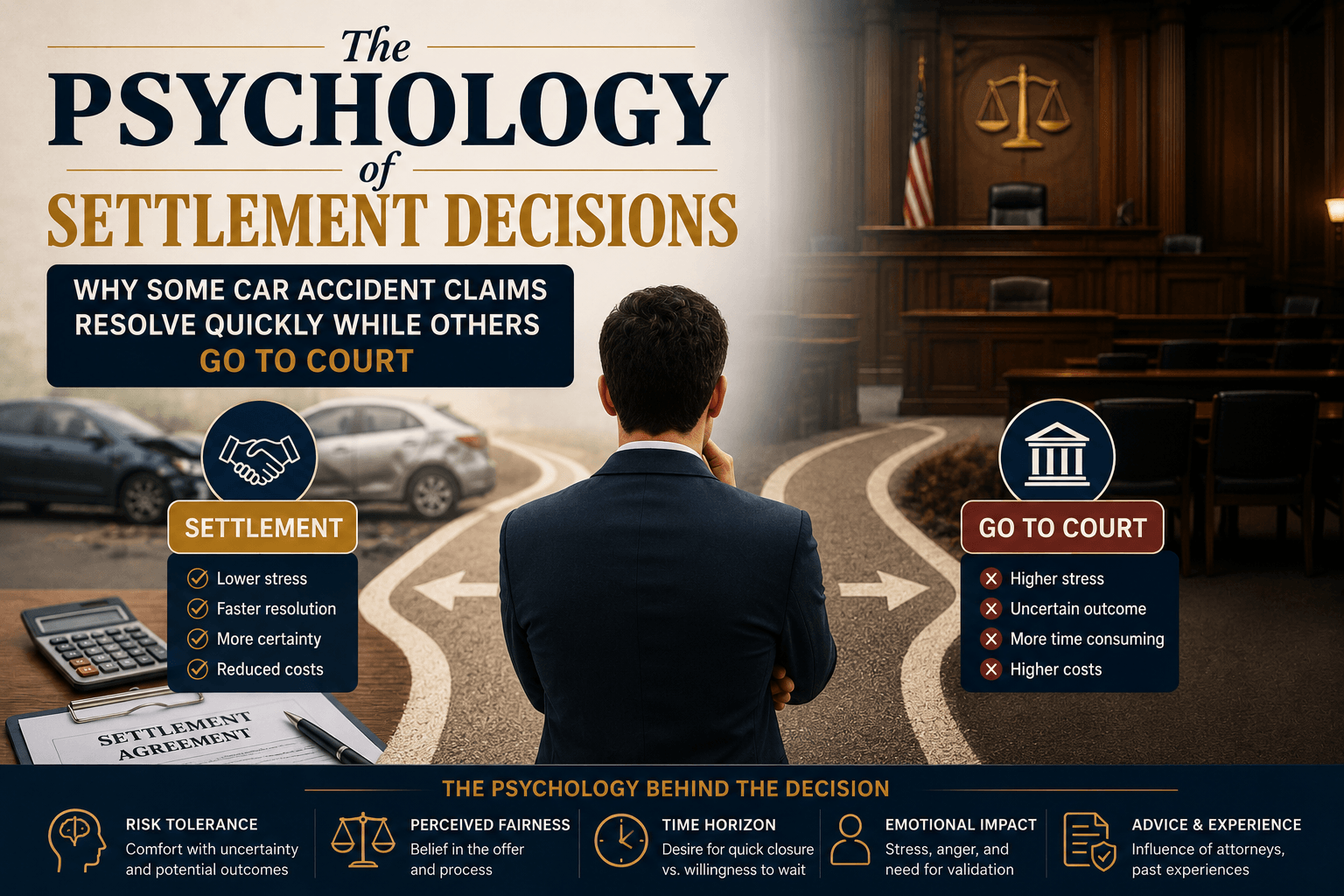
Settlement is generally attractive to all parties involved because it offers certainty.
When a claim settles:
- Compensation is determined without trial.
- Legal expenses may be reduced.
- Resolution often occurs more quickly.
- Emotional stress may be minimized.
- Outcomes become more predictable.
Court proceedings introduce uncertainty. Even strong cases can face unexpected challenges during litigation.
As a result, both claimants and insurers often prefer to negotiate a resolution when possible.
The Human Side of Negotiation
While claims are often discussed in terms of evidence and compensation, negotiations are ultimately conducted by people.
People bring personal factors into the process, including:
- Emotions
- Assumptions
- Biases
- Risk tolerance
- Communication preferences
- Expectations
Two individuals reviewing the same claim may reach different conclusions regarding its value and potential outcome.
This human element helps explain why settlement negotiations are rarely as simple as calculating medical expenses and vehicle repair costs.
The Role of Expectations
One of the most common reasons negotiations become difficult involves differing expectations.
Claimant Expectations
Accident victims often focus on:
- Physical suffering
- Financial hardship
- Recovery challenges
- Future uncertainties
These experiences can shape their perception of what constitutes fair compensation.
Insurance Company Expectations
Insurers typically evaluate claims based on:
- Available evidence
- Policy terms
- Liability assessments
- Historical claim data
- Potential litigation risks
When the parties have significantly different views regarding claim value, negotiations may become more complicated.
How Emotions Influence Settlement Decisions
Car accidents can be highly emotional experiences.
Victims may experience:
- Frustration
- Anxiety
- Fear
- Anger
- Stress
These emotions are understandable, especially when injuries, financial difficulties, or long recovery periods are involved.
At the same time, emotional reactions can sometimes influence decision-making.
For example:
- A claimant may reject a reasonable offer out of frustration.
- An insurer may take a more cautious approach when liability remains disputed.
- Misunderstandings can escalate tensions unnecessarily.
Recognizing the emotional aspects of negotiations can help parties approach discussions more constructively.
Risk Perception and Decision-Making
One of the most important psychological factors in settlement negotiations is risk perception.
Every settlement decision involves uncertainty.
The Claimant’s Perspective
Claimants may ask:
- What if a court awards less than expected?
- How long will litigation take?
- What additional expenses may arise?
- Is immediate compensation preferable?
The Insurer’s Perspective
Insurers may consider:
- The possibility of larger verdicts
- Litigation costs
- Reputation concerns
- Evidence strength
- Jury unpredictability
Settlement discussions often revolve around how each side evaluates these risks.
Why Clear Liability Leads to Faster Settlements
Claims involving obvious fault frequently resolve more efficiently.
Examples include:
- Rear-end collisions
- Red-light violations captured on video
- Admissions of responsibility
- Strong witness evidence
When liability is clear, negotiations can focus primarily on damages and compensation.
By contrast, disputed liability often creates additional obstacles that slow the settlement process.
The Impact of Uncertain Liability
Liability disputes frequently become major barriers to settlement.
Questions may arise regarding:
- Driver behavior
- Road conditions
- Vehicle defects
- Shared responsibility
When parties disagree about fault, both sides may become less willing to compromise until additional evidence becomes available.
These disputes often increase investigation time and prolong negotiations.
Injury Severity and Settlement Complexity
The seriousness of injuries can significantly affect claim resolution timelines.
Minor Injury Claims
Cases involving relatively straightforward injuries may settle more quickly because future medical costs and recovery timelines are easier to estimate.
Severe Injury Claims
Serious injuries often introduce greater uncertainty regarding:
- Long-term treatment
- Rehabilitation needs
- Lost earning capacity
- Future quality of life
Because the financial stakes are higher, negotiations tend to receive greater scrutiny.
The Importance of Medical Certainty
Settlement discussions often become more productive once medical conditions stabilize.
Before reaching maximum medical improvement, questions may remain regarding:
- Future treatment requirements
- Permanent limitations
- Long-term recovery prospects
Settling too early may create risks if future complications emerge.
As a result, some claims remain unresolved until medical professionals can provide clearer projections regarding long-term outcomes.
Anchoring: A Common Negotiation Principle
Psychologists use the term “anchoring” to describe how initial numbers influence later discussions.
In settlement negotiations:
- One side presents an initial demand.
- The other responds with an offer.
- Future discussions often revolve around those starting figures.
Even when initial numbers are adjusted significantly, they can shape expectations throughout the negotiation process.
Understanding this principle helps explain why opening positions sometimes differ substantially from final settlement amounts.
The Influence of Time
Time affects settlement decisions in several ways.
Financial Pressure
Accident victims may face:
- Medical expenses
- Lost income
- Household obligations
Financial stress can influence willingness to settle.
Litigation Costs
As disputes continue, legal and administrative costs may increase for all parties involved.
Emotional Fatigue
Lengthy negotiations can become exhausting.
Over time, some parties become more motivated to reach resolution simply to move forward with their lives.
Why Documentation Strengthens Negotiations
Evidence often influences settlement discussions more than opinions.
Strong documentation may include:
- Medical records
- Diagnostic reports
- Accident photographs
- Witness statements
- Employment records
- Expert evaluations
The more clearly losses can be demonstrated, the easier it becomes to support compensation requests.
Well-supported claims frequently create stronger negotiating positions.
The Role of Credibility
Credibility can significantly impact settlement outcomes.
Adjusters, attorneys, and investigators often assess:
- Consistency of statements
- Accuracy of records
- Reliability of evidence
- Overall trustworthiness
When credibility concerns arise, negotiations may become more difficult.
Consistent documentation and accurate reporting help establish confidence in a claim.
Why Some Cases Proceed to Court
Despite extensive negotiations, some disputes cannot be resolved through settlement alone.
Common reasons include:
Major Disagreements About Liability
Parties may fundamentally disagree regarding who caused the accident.
Disputes Over Injury Severity
Questions may arise regarding the extent of injuries and future impacts.
Significant Compensation Differences
The gap between settlement expectations may remain too large to bridge.
Strategic Considerations
In some situations, litigation may be viewed as the most effective path toward resolution.
Court proceedings allow judges or juries to evaluate evidence and determine outcomes when negotiations fail.
The Psychological Value of Closure
Settlement decisions are not always based solely on financial considerations.
Many individuals seek:
- Closure
- Accountability
- Peace of mind
- Certainty
Resolving a claim can represent an important step toward emotional recovery following a traumatic event.
The desire to move forward often becomes a meaningful factor during negotiations.
How Communication Influences Outcomes
Effective communication plays an important role throughout the settlement process.
Constructive communication can:
- Clarify misunderstandings
- Reduce conflict
- Encourage cooperation
- Improve problem-solving
Poor communication, on the other hand, may increase frustration and delay progress.
Many successful settlements result from productive discussions that focus on evidence and realistic expectations.
The Growing Role of Alternative Dispute Resolution
Not every unresolved claim proceeds directly to trial.
Alternative dispute resolution methods may include:
Mediation
A neutral third party helps facilitate settlement discussions.
Arbitration
An independent decision-maker reviews evidence and issues a determination.
These approaches can sometimes provide faster and less adversarial paths toward resolution.
Understanding Settlement Timing
There is no universal timeline for accident claim resolution.
Factors that influence timing include:
- Injury severity
- Medical treatment duration
- Evidence availability
- Liability disputes
- Negotiation progress
- Litigation considerations
Some claims settle within a matter of months, while others require considerably more time.
Each case follows its own unique path based on the circumstances involved.
Balancing Certainty and Opportunity
Every settlement decision involves balancing certainty against possibility.
Accepting a settlement provides:
- Immediate resolution
- Predictability
- Reduced uncertainty
Continuing negotiations or pursuing litigation may offer:
- Potentially higher compensation
- Additional evidence development
- Judicial review
Neither path is inherently right or wrong.
The appropriate decision depends on the facts of the case, available evidence, and individual priorities.
Conclusion
The car accident settlement process involves much more than numbers on a spreadsheet. Psychological factors, emotional responses, risk assessments, communication strategies, and expectations all influence how claims progress and ultimately resolve.
While many cases settle efficiently because both parties recognize the benefits of certainty, others become more complicated due to liability disputes, injury questions, or differing views regarding compensation. Understanding these dynamics can help claimants better navigate negotiations and appreciate why seemingly similar claims often produce very different outcomes.
Whether a claim resolves through settlement, mediation, arbitration, or litigation, informed decision-making remains one of the most valuable tools available to anyone seeking a fair resolution after a car accident.
Frequently Asked Questions
Why do most car accident claims settle?
Most claims settle because settlement provides certainty, reduces litigation costs, and often resolves disputes more quickly than court proceedings.
What causes settlement negotiations to fail?
Common reasons include disagreements about liability, injury severity, compensation amounts, and future financial losses.
Does every car accident claim go to court?
No. The majority of claims are resolved through settlement negotiations before reaching trial.
What is mediation in a car accident claim?
Mediation involves a neutral third party who helps participants discuss settlement options and work toward a mutually acceptable resolution.
Why can serious injury claims take longer to settle?
Severe injuries often require additional medical evaluation, future cost analysis, and detailed investigation before compensation can be accurately assessed.