
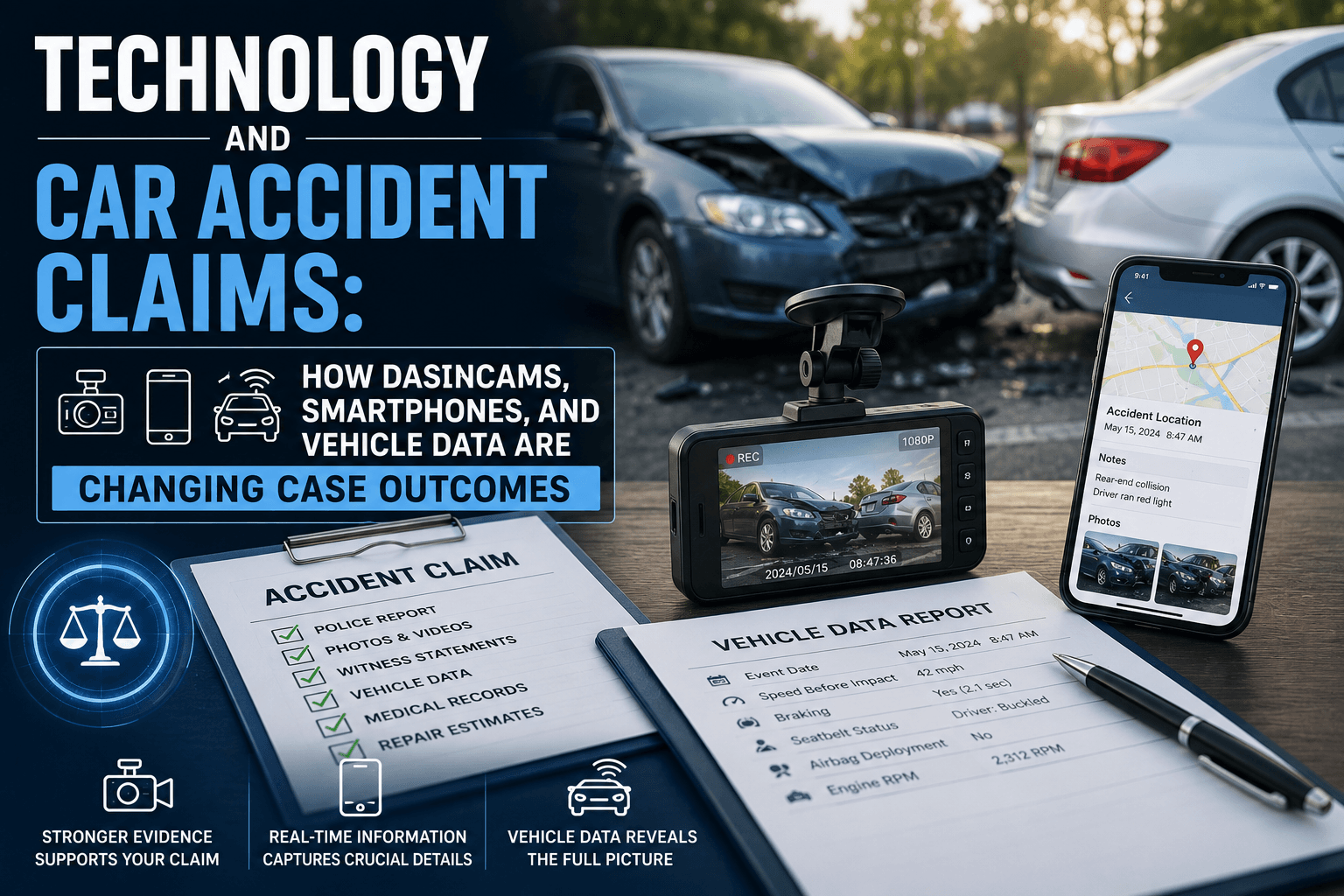

Not long ago, most car accident claims relied heavily on eyewitness testimony, police reports, and photographs taken after a collision. While these forms of evidence remain important, technology has dramatically changed how accidents are investigated, documented, and resolved.
Today, a growing number of vehicles, mobile devices, and digital systems continuously collect information that can provide valuable insight into what happened before, during, and after a crash. From dashcam recordings and smartphone photos to vehicle telematics and event data recorders, technology has introduced new layers of evidence that were largely unavailable just a decade ago.
For drivers, passengers, insurers, and legal professionals, these technological advancements are reshaping the claims process. In many cases, digital evidence can help clarify liability, support injury claims, and reduce disputes that once depended largely on conflicting accounts.
This article explores how modern technology is transforming car accident claims and why digital evidence is becoming an increasingly important factor in determining case outcomes.
The Evolution of Accident Evidence
Historically, accident investigations often relied on three primary sources of information:
- Driver statements
- Witness testimony
- Physical evidence from the scene
While these sources remain valuable, they are not always perfect.
Witnesses may have limited visibility, memories can fade, and different parties may interpret events differently.
Technology has introduced new forms of evidence that can provide objective information about vehicle movements, impact forces, driver behavior, and road conditions.
As a result, many accident investigations now incorporate digital data alongside traditional evidence.
The Growing Popularity of Dashcams
Dashcams have become one of the most influential technologies in modern accident investigations.
These compact cameras continuously record the road ahead and, in some cases, the vehicle’s interior and rear surroundings.
How Dashcams Help
Dashcam footage can provide:
- Visual evidence of the collision
- Traffic signal conditions
- Road hazards
- Driver behavior
- Weather conditions
- Vehicle positioning
Instead of relying solely on verbal descriptions, investigators may review video footage that captures events as they occur.
Clarifying Liability
One of the most significant advantages of dashcams is their ability to clarify fault.
Footage may reveal:
- Failure to yield
- Unsafe lane changes
- Red-light violations
- Distracted driving
- Aggressive driving behavior
In situations where parties provide conflicting accounts, video evidence can offer a more complete picture of the incident.
Smartphones as Evidence Collection Tools
Modern smartphones have effectively become portable accident documentation devices.
Within minutes of a collision, drivers can use their phones to gather important information.
Photos and Videos
Smartphones allow individuals to capture:
- Vehicle damage
- Road conditions
- Traffic signs
- Skid marks
- Injuries
- Weather conditions
These images often become valuable evidence during claim investigations.
Location Data
Many smartphones automatically record location information through GPS technology.
This data may help verify:
- Accident location
- Travel routes
- Timing of events
While GPS information alone rarely determines liability, it can contribute to a broader understanding of the circumstances surrounding a collision.
Digital Communication Records
Text messages, emails, and app-based communications may sometimes become relevant during investigations, particularly when distracted driving is suspected.
Vehicle Event Data Recorders: The Automotive “Black Box”
Many modern vehicles contain event data recorders (EDRs), commonly referred to as automotive black boxes.
These devices collect technical information about vehicle operation before, during, and immediately after a crash.
What Information Is Recorded?
Depending on the vehicle, EDRs may capture:
- Vehicle speed
- Brake application
- Steering inputs
- Seatbelt usage
- Airbag deployment
- Engine performance
- Acceleration and deceleration data
The information is generally stored for a limited period surrounding the collision event.
Why Black Box Data Matters
Black box data can provide objective insights into:
- Whether braking occurred
- Vehicle speed before impact
- Collision severity
- Driver reactions
This information may help reconstruct accidents and verify or challenge statements made by involved parties.
Telematics and Connected Vehicles
Modern vehicles increasingly rely on telematics systems that collect and transmit driving-related information.
Connected vehicle technologies may record:
- Speed patterns
- Driving habits
- Location history
- Vehicle diagnostics
- Maintenance alerts
Insurance companies and accident investigators sometimes use telematics data when evaluating claims.
As connected vehicles become more common, telematics may play an increasingly important role in accident investigations.
Traffic Cameras and Public Surveillance Systems
Many urban areas utilize surveillance systems designed to monitor traffic flow and improve road safety.
These systems may include:
- Intersection cameras
- Highway monitoring cameras
- Municipal surveillance networks
- Toll road cameras
Video footage from these sources can sometimes provide independent evidence regarding how an accident occurred.
In cases involving disputed liability, public camera footage may become an important investigative resource.
Business Security Cameras and Private Surveillance
Not all useful footage comes from public agencies.
Businesses, residential properties, and parking facilities frequently use security cameras that may capture nearby roadways.
Potential sources include:
- Retail stores
- Gas stations
- Office buildings
- Residential doorbell cameras
- Parking structures
These recordings may provide valuable perspectives that supplement other evidence.
Accident Reconstruction Through Technology
Accident reconstruction has become increasingly sophisticated due to advances in technology.
Investigators may combine:
- Vehicle data
- GPS information
- Dashcam footage
- Physical evidence
- Computer simulations
These tools help recreate accident scenarios with greater precision than was previously possible.
Advanced reconstruction techniques can assist in determining:
- Vehicle trajectories
- Collision timing
- Speed estimates
- Impact dynamics
This information often becomes useful when disputes arise regarding fault or injury causation.
Wearable Technology and Injury Documentation
Wearable devices are becoming increasingly common.
Examples include:
- Smartwatches
- Fitness trackers
- Health monitoring devices
Some devices collect information related to:
- Heart rate
- Physical activity
- Sleep patterns
- Mobility levels
In certain circumstances, this data may help illustrate changes in physical condition following an accident.
For example, activity tracking information may demonstrate reduced mobility during recovery periods.
Artificial Intelligence in Claims Processing
Insurance companies are increasingly incorporating artificial intelligence into claims evaluation processes.
AI systems may assist with:
- Damage assessments
- Fraud detection
- Claim prioritization
- Documentation review
- Settlement projections
These tools allow insurers to process large volumes of claims more efficiently.
However, human review remains an important component of many claims decisions, particularly in complex cases involving significant injuries.
Digital Evidence and Liability Disputes
One of the most significant impacts of technology involves the resolution of liability disputes.
Traditionally, fault determinations often depended on competing narratives.
Digital evidence may provide:
- Time-stamped recordings
- Vehicle performance data
- Geographic information
- Independent visual documentation
As more objective evidence becomes available, some disputes can be resolved more efficiently.
This does not eliminate disagreements entirely, but it can provide stronger factual foundations for investigations.
Challenges Associated With Digital Evidence
While technology offers many benefits, it also presents challenges.
Data Availability
Not all vehicles contain the same technologies, and not every accident is captured on video.
Privacy Concerns
Questions may arise regarding access to personal information, vehicle data, and location records.
Data Interpretation
Technical data often requires expert analysis to ensure accurate interpretation.
Storage Limitations
Certain systems overwrite information after a limited period, making timely evidence preservation important.
Understanding these limitations helps create realistic expectations regarding the role of technology in accident claims.
Social Media and Accident Claims
Social media has introduced another layer of digital evidence.
Publicly available content may sometimes be reviewed during claim investigations.
Examples include:
- Photos
- Videos
- Status updates
- Activity posts
While social media content rarely tells the full story, it may influence how claims are evaluated if posts appear inconsistent with reported injuries or recovery limitations.
For this reason, many accident victims exercise caution when sharing information publicly during an ongoing claim.
The Future of Self-Driving and Semi-Autonomous Vehicles
Advancements in autonomous driving technology are likely to create new challenges and opportunities for accident investigations.
Future claims may involve data from:
- Automated driving systems
- Driver assistance technologies
- Sensor networks
- Vehicle-to-vehicle communication systems
Questions regarding liability may become more complex as responsibility shifts between drivers, software systems, manufacturers, and other parties.
The legal and insurance industries continue to adapt to these emerging technologies.
Why Evidence Preservation Matters
Technology is most useful when evidence is preserved properly.
Following an accident, important steps may include:
- Saving dashcam footage
- Backing up photographs
- Retaining communication records
- Documenting vehicle information
- Preserving digital files
Because some systems automatically overwrite data, prompt action can help prevent the loss of potentially valuable evidence.
A New Era of Accident Investigations
Technology has fundamentally changed how car accident claims are investigated and evaluated.
What once depended largely on witness accounts and physical observations now often involves a combination of video recordings, vehicle data, digital communications, telematics information, and sophisticated analytical tools.
These advancements provide opportunities to better understand how accidents occur while helping support more informed decision-making throughout the claims process.
Conclusion
The role of technology in car accident claims continues to expand as vehicles, smartphones, and connected systems become increasingly sophisticated. Dashcams, black box data, GPS records, surveillance footage, and digital documentation have transformed the way accidents are investigated and how liability is assessed.
While traditional evidence remains important, digital information often provides valuable context that can strengthen investigations and reduce uncertainty. As technology continues to evolve, its influence on accident claims, insurance evaluations, and legal proceedings is likely to grow even further.
For drivers and accident victims, understanding these technological developments can help ensure that valuable evidence is recognized, preserved, and used effectively when navigating the aftermath of a collision.
Frequently Asked Questions
What is a vehicle black box?
A vehicle black box, also known as an event data recorder (EDR), is a device that records certain vehicle performance information before, during, and after a collision.
Can dashcam footage be used in accident claims?
Yes. Dashcam footage is often used as evidence to help clarify accident circumstances, liability issues, and road conditions.
Do smartphones help document car accidents?
Yes. Smartphones can capture photographs, videos, location data, and other information that may support accident investigations.
What is telematics?
Telematics refers to technology that collects and transmits information about vehicle operation, driving behavior, and performance.
Can social media affect a car accident claim?
In some situations, publicly available social media content may be reviewed during claim investigations if it relates to reported injuries or accident circumstances.