
The commercial trucking industry is responsible for transporting the majority of goods across the United States, making it an essential part of the nation’s economy. Because commercial trucks are significantly larger and heavier than passenger vehicles, federal lawmakers have established extensive safety regulations designed to reduce accidents, improve driver safety, and promote responsible transportation practices.
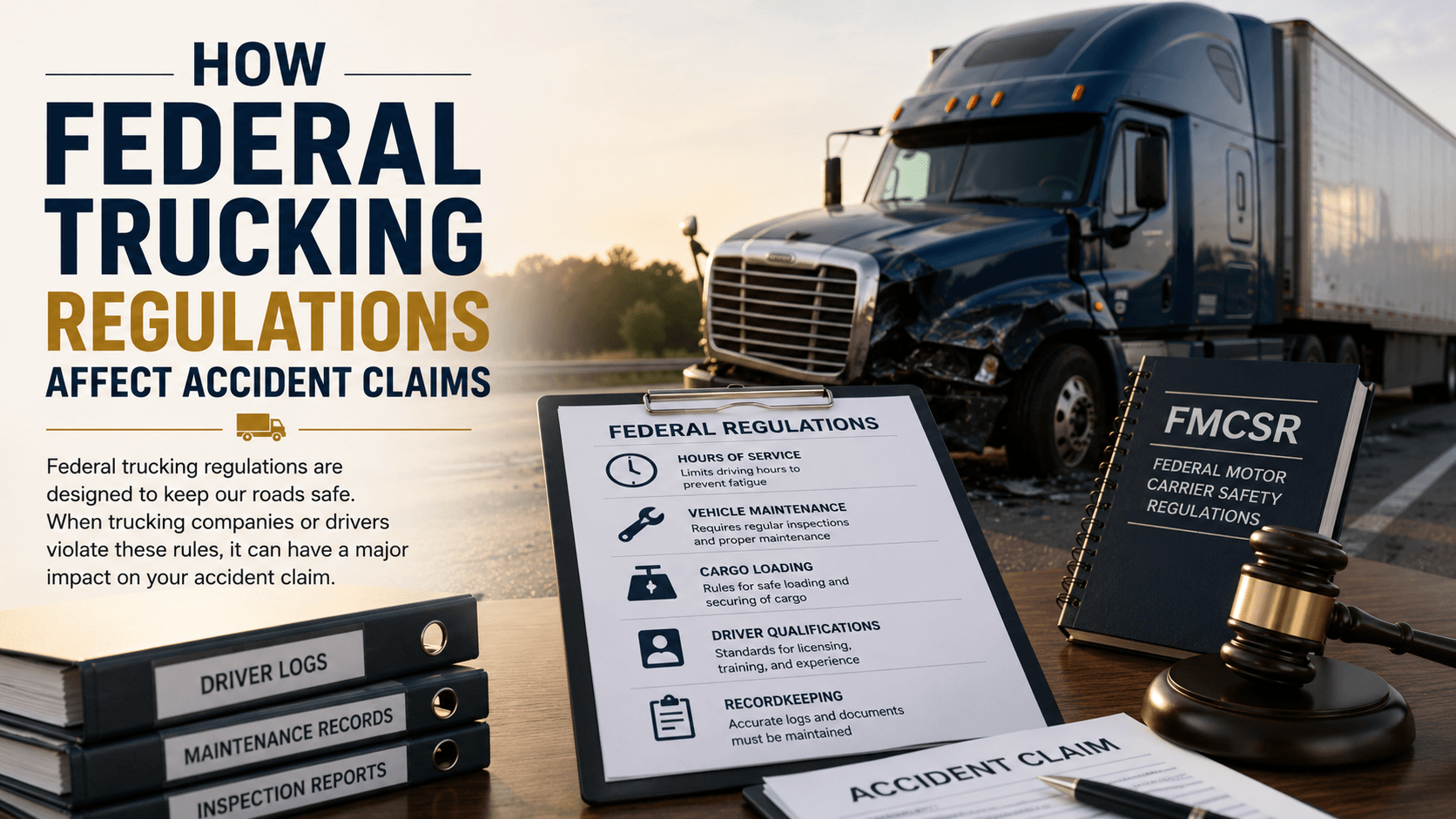
These regulations govern nearly every aspect of commercial trucking, including driver qualifications, operating hours, vehicle inspections, maintenance, cargo securement, and recordkeeping. When a truck accident occurs, investigators often examine whether these safety requirements were followed and whether any violations contributed to the collision.
Understanding how federal trucking regulations affect accident claims helps explain why truck accident investigations are often more detailed than ordinary motor vehicle accident cases and why compliance records frequently become important evidence.
What Are Federal Trucking Regulations?
Federal trucking regulations are safety rules that govern many aspects of commercial motor vehicle operations.
These regulations are intended to:
- Improve highway safety
- Reduce commercial vehicle accidents
- Protect drivers and the public
- Standardize transportation practices
- Promote vehicle maintenance
- Encourage responsible fleet management
Commercial carriers operating in interstate commerce are generally subject to these regulations, although state laws and additional requirements may also apply.
Why Trucking Regulations Matter
Commercial trucks present unique safety challenges because of their:
- Large size
- Heavy weight
- Longer stopping distances
- Hazardous cargo in some cases
- Extended operating schedules
- Complex mechanical systems
Federal regulations establish consistent safety standards that help reduce risks throughout the transportation industry.
Driver Qualification Requirements
Commercial drivers generally must satisfy qualification standards before operating certain commercial vehicles.
Requirements may include:
- Appropriate commercial driver’s license (CDL)
- Medical certification
- Driving history review
- Drug and alcohol testing
- Required training
- Ongoing qualification monitoring
Driver qualification records may become relevant during accident investigations.
Hours-of-Service Rules
Driver fatigue is a well-recognized safety concern in commercial transportation.
Hours-of-service regulations generally establish limits on:
- Daily driving time
- Total on-duty hours
- Mandatory rest breaks
- Weekly driving limits
- Restart periods
These rules are designed to reduce fatigue-related accidents and promote safer driving practices.
Electronic Logging Devices (ELDs)
Many commercial drivers use Electronic Logging Devices (ELDs) to record driving activity.
ELDs may document:
- Driving hours
- Duty status
- Vehicle movement
- Engine operation
- Location information
- Operating times
During accident investigations, these electronic records may help verify compliance with hours-of-service requirements.
Vehicle Inspection Requirements
Commercial vehicles generally require regular inspections to help ensure safe operation.
Inspection programs may include:
- Daily inspections
- Periodic maintenance inspections
- Annual inspections
- Brake evaluations
- Tire inspections
- Lighting checks
- Steering system reviews
Inspection records often become important evidence following a truck accident.
Maintenance Requirements
Commercial carriers are generally responsible for maintaining vehicles in safe operating condition.
Maintenance programs may address:
- Brake systems
- Tires
- Suspension
- Steering
- Coupling devices
- Engine components
- Electrical systems
- Safety equipment
Proper maintenance helps reduce the risk of mechanical failures while supporting regulatory compliance.
Cargo Securement Rules
Improperly loaded cargo may create significant safety hazards.
Cargo securement regulations generally address:
- Weight distribution
- Tie-down requirements
- Hazardous materials
- Cargo restraints
- Specialized equipment
- Inspection procedures
Proper cargo securement reduces the risk of shifting loads, rollovers, and roadway debris.
Drug and Alcohol Testing
Commercial drivers are generally subject to comprehensive drug and alcohol testing requirements.
Testing programs may include:
- Pre-employment testing
- Random testing
- Post-accident testing
- Reasonable suspicion testing
- Return-to-duty testing
- Follow-up testing
These requirements help promote safe commercial vehicle operation.
Recordkeeping Requirements
Federal regulations require many commercial carriers to maintain extensive operational records.
Examples include:
- Driver qualification files
- Maintenance records
- Inspection reports
- Hours-of-service records
- Drug testing documentation
- Vehicle registration information
- Training records
These documents often assist investigators when reviewing accident claims.
How Regulations Affect Accident Investigations
Following a truck accident, investigators may review whether applicable safety regulations were followed.
The investigation may include examining:
- Driver qualifications
- Hours-of-service compliance
- Vehicle inspections
- Maintenance history
- Cargo loading procedures
- Safety policies
- Training records
- Electronic data
Regulatory compliance is one factor that may help investigators understand the circumstances surrounding a collision.
Regulatory Compliance and Liability
Compliance with safety regulations does not automatically determine liability.
Likewise, an alleged regulatory violation does not automatically establish legal responsibility.
Instead, investigators typically consider:
- The facts of the accident
- Available evidence
- Applicable legal standards
- Causation
- Comparative negligence, where applicable
Each truck accident claim is evaluated individually.
Common Misconceptions About Trucking Regulations
Myth: Federal Regulations Apply to Every Truck on the Road
Federal regulations generally apply to many commercial motor vehicles operating in interstate commerce, while state laws and additional rules may govern other commercial operations.
Myth: Every Regulatory Violation Causes an Accident
A regulatory violation may become relevant during an investigation, but investigators must also evaluate whether it actually contributed to the collision.
Myth: Truck Drivers Are the Only People Responsible for Compliance
Responsibility for regulatory compliance may involve trucking companies, maintenance personnel, supervisors, and other organizations depending on the specific requirement.
Myth: Compliance Eliminates All Accident Risks
Even when regulations are followed, accidents may still occur because of weather, roadway conditions, actions of other drivers, or unforeseen mechanical failures.
Technology Supporting Regulatory Compliance
Modern technology has improved commercial trucking safety and compliance.
Examples include:
- Electronic logging devices
- GPS fleet management
- Driver monitoring systems
- Predictive maintenance software
- Electronic inspection reporting
- Collision avoidance technology
- Fleet telematics
- Digital compliance management systems
These technologies help carriers improve operational safety while maintaining required records.
The Future of Trucking Regulations
The commercial transportation industry continues evolving alongside new technologies.
Future developments may include:
- Autonomous commercial vehicles
- Artificial intelligence-assisted safety monitoring
- Connected vehicle communication
- Enhanced predictive maintenance
- Smart highway infrastructure
- Advanced electronic inspection systems
- Expanded data analytics
- Improved collision prevention technologies
As transportation evolves, regulatory frameworks will likely continue adapting to address emerging safety challenges.
Conclusion
Federal trucking regulations play an important role in promoting safety throughout the commercial transportation industry. From driver qualifications and hours-of-service limits to vehicle maintenance, inspections, cargo securement, and recordkeeping, these regulations establish standards designed to reduce accidents and improve highway safety.
When truck accidents occur, investigators often examine compliance records alongside other evidence to better understand the circumstances surrounding the collision. Although regulatory compliance alone does not determine liability, it frequently forms an important part of a comprehensive accident investigation. Understanding these regulations helps explain why truck accident claims often require detailed analysis, specialized evidence, and careful evaluation of commercial transportation practices.
Frequently Asked Questions
What are federal trucking regulations?
Federal trucking regulations are safety rules that govern many aspects of commercial motor vehicle operations, including driver qualifications, hours of service, maintenance, inspections, cargo securement, and recordkeeping.
Why are trucking regulations important in accident claims?
Investigators may review compliance with applicable regulations when determining how a truck accident occurred and evaluating evidence related to the claim.
What are hours-of-service rules?
Hours-of-service rules establish limits on driving time and require mandatory rest periods to help reduce fatigue-related commercial vehicle accidents.
What records are important after a truck accident?
Common records include driver qualification files, electronic logging device data, maintenance records, inspection reports, training documentation, and cargo records.
Does violating a trucking regulation automatically make someone liable?
No. Regulatory compliance is one factor considered during an investigation. Liability depends on the specific facts, available evidence, and applicable legal standards.