

Modern products, pharmaceuticals, medical devices, transportation systems, and consumer goods are often used by millions of people every day. While most products and services perform as intended, there are occasions when a defective product, hazardous substance, unsafe medication, or widespread act of negligence causes injuries to a large number of individuals. When many people suffer similar harm from the same source, the legal system may address these claims through mass tort litigation.
Mass tort litigation has become one of the most significant areas of civil law because it allows courts to efficiently manage numerous related claims while still recognizing that every injured person’s experience is unique. Unlike lawsuits involving a single plaintiff or a traditional class action, mass tort litigation combines efficiency with individualized consideration of damages and evidence.
Understanding how mass tort litigation works can help individuals better appreciate the legal processes involved in large-scale civil disputes. This guide explains the fundamentals of mass tort litigation, how these cases develop, and why they remain an important part of modern legal systems.
What Is Mass Tort Litigation?
Mass tort litigation is a legal process used when many individuals suffer injuries or losses arising from the same product, event, medication, medical device, environmental exposure, or other common source.
Rather than filing one collective lawsuit with identical outcomes, each plaintiff maintains an individual claim while certain legal issues are handled together to improve efficiency.
This approach allows courts to address common questions without eliminating the unique facts surrounding each person’s injuries.
Why Mass Tort Litigation Exists
Without mass tort procedures, courts could face thousands of nearly identical lawsuits involving:
- Similar evidence
- The same defendants
- Common scientific questions
- Shared expert testimony
- Identical product information
Handling each case entirely separately would require enormous judicial resources and could lead to inconsistent outcomes.
Mass tort litigation helps streamline complex legal proceedings while preserving each plaintiff’s right to pursue individual compensation based on their specific circumstances.
Common Types of Mass Tort Cases
Mass tort litigation may involve a wide range of situations.
Examples include:
- Defective prescription medications
- Faulty medical devices
- Dangerous consumer products
- Toxic chemical exposure
- Environmental contamination
- Industrial accidents
- Large transportation disasters
- Defective automotive components
Although the underlying events differ, these cases generally involve multiple people alleging similar harm caused by the same source.
How a Mass Tort Case Begins
Most mass tort cases begin when reports emerge suggesting that multiple individuals have experienced similar injuries.
Early stages often involve:
- Individual legal consultations
- Investigation of reported injuries
- Collection of medical records
- Scientific research
- Review of regulatory information
- Evaluation of product history
As additional claims arise, courts may determine that coordinated case management would improve efficiency.
Consolidating Similar Cases
One of the defining characteristics of mass tort litigation is coordinated case management.
Rather than combining every plaintiff into a single lawsuit, courts may consolidate certain pretrial activities.
These commonly include:
- Evidence collection
- Expert witness testimony
- Scientific evaluations
- Discovery procedures
- Legal motions
This reduces unnecessary duplication while allowing each plaintiff to maintain an individual claim.
Individual Claims Remain Important
Unlike some forms of collective litigation, every plaintiff in a mass tort case generally retains an individual legal claim.
Factors that may differ between plaintiffs include:
- Severity of injuries
- Medical history
- Financial losses
- Lost income
- Recovery time
- Long-term medical needs
- Pain and suffering
Because these circumstances vary, compensation is often evaluated individually rather than equally across all participants.
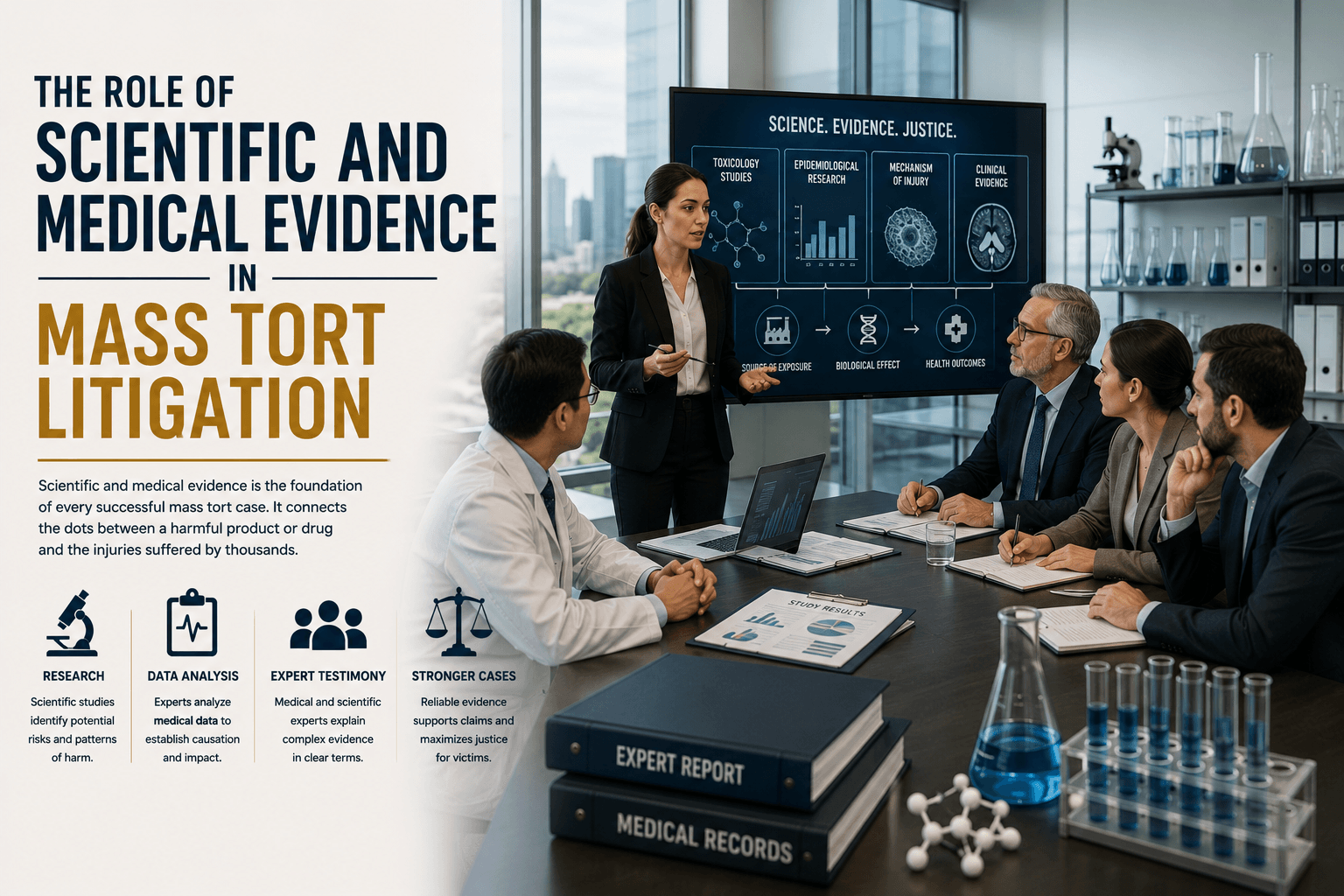
The Role of Scientific Evidence
Scientific evidence is frequently at the center of mass tort litigation.
Depending on the case, evidence may include:
- Clinical studies
- Laboratory testing
- Engineering reports
- Toxicology research
- Medical literature
- Product testing
- Regulatory findings
Expert witnesses often help explain complex scientific issues to the court.
Reliable scientific evidence is essential because many mass tort cases involve technical questions beyond ordinary experience.
Medical Documentation
Medical records play a critical role in demonstrating both injury and causation.
Supporting documentation may include:
- Hospital records
- Physician reports
- Diagnostic imaging
- Laboratory results
- Surgical records
- Rehabilitation reports
- Treatment history
These records help establish how the alleged event affected each individual plaintiff.
The Discovery Process
Discovery is the stage during which both sides exchange relevant information.
Discovery may involve:
- Document production
- Written questions
- Depositions
- Expert reports
- Corporate records
- Internal communications
Because mass tort litigation often involves thousands of documents, discovery can become one of the most time-consuming phases of the case.
Bellwether Trials
Many large mass tort proceedings include bellwether trials.
A bellwether trial involves selecting a small number of representative cases to proceed to trial before the remaining claims.
These trials help both parties better understand:
- How juries evaluate evidence
- Strengths and weaknesses of legal arguments
- Potential settlement considerations
Bellwether verdicts generally do not determine the outcome of every remaining case, but they often influence future negotiations.
Possible Outcomes
Mass tort litigation can conclude in several ways.
Potential outcomes include:
- Individual settlements
- Group settlement programs
- Court judgments
- Trial verdicts
- Dismissal of claims where appropriate
Every plaintiff’s outcome depends on the specific facts and evidence supporting their individual case.
Challenges in Mass Tort Litigation
Mass tort litigation presents unique challenges for everyone involved.
These may include:
- Large volumes of evidence
- Complex scientific issues
- Multiple expert witnesses
- Lengthy court proceedings
- Individual medical evaluations
- Coordination among numerous parties
Despite these challenges, coordinated proceedings often remain more efficient than thousands of separate lawsuits.
Benefits of Mass Tort Litigation
Mass tort litigation offers several advantages.
These include:
- More efficient court management.
- Consistent handling of shared legal issues.
- Reduced duplication of evidence.
- Preservation of individual claims.
- Greater access to expert testimony.
- Improved coordination among parties.
This balance between efficiency and individualized justice distinguishes mass tort litigation from many other legal processes.
Common Misconceptions
Myth: Every Plaintiff Receives the Same Compensation.
Not necessarily.
Because each claim remains individual, compensation often depends on the person’s injuries, medical expenses, financial losses, and other case-specific factors.
Myth: Mass Tort Litigation Is the Same as a Class Action.
Although both involve multiple plaintiffs, they operate differently.
Mass tort litigation generally preserves individual claims, while class actions typically resolve claims collectively.
Myth: Large Cases Always Reach Trial.
Many mass tort cases resolve through negotiated settlements before every claim reaches a courtroom.
Looking Toward the Future
Advances in medicine, engineering, manufacturing, and technology continue influencing mass tort litigation.
Modern cases increasingly involve:
- Digital medical records
- Advanced product testing
- Artificial intelligence analysis
- Electronic discovery
- Large scientific databases
- Global product distribution
As products become more complex and international supply chains continue expanding, courts will likely face increasingly sophisticated mass tort cases involving emerging technologies and evolving scientific evidence.
Legal systems continue adapting to balance efficiency with fairness while ensuring injured individuals have meaningful opportunities to present their claims.
Conclusion
Mass tort litigation provides an important legal framework for addressing situations in which numerous individuals experience similar harm arising from a common source. By coordinating shared legal issues while preserving individual claims, mass tort proceedings help courts efficiently manage complex litigation without overlooking the unique circumstances of each plaintiff.
Although these cases often involve extensive scientific evidence, medical documentation, and lengthy legal proceedings, their underlying purpose remains straightforward: ensuring that complex disputes involving multiple injured individuals can be handled fairly, consistently, and efficiently. Understanding how mass tort litigation works allows individuals to better appreciate one of the most significant areas of modern civil justice.
Frequently Asked Questions
What is mass tort litigation?
Mass tort litigation is a legal process used when many individuals file separate claims involving similar injuries caused by the same product, event, or source while maintaining individual lawsuits.
How is mass tort litigation different from a class action?
In mass tort litigation, each plaintiff generally retains an individual claim and compensation is evaluated separately, whereas class actions typically resolve claims on behalf of an entire group.
What types of cases become mass torts?
Common examples include defective medications, faulty medical devices, toxic exposure, dangerous consumer products, environmental contamination, and certain transportation disasters.
Why is scientific evidence important in mass tort litigation?
Scientific evidence helps establish whether the alleged product, substance, or event could have caused the reported injuries and supports expert testimony presented during litigation.
Does every plaintiff receive the same settlement?
No. Because each claim is evaluated individually, compensation often depends on the severity of injuries, medical treatment, financial losses, and other case-specific factors.