
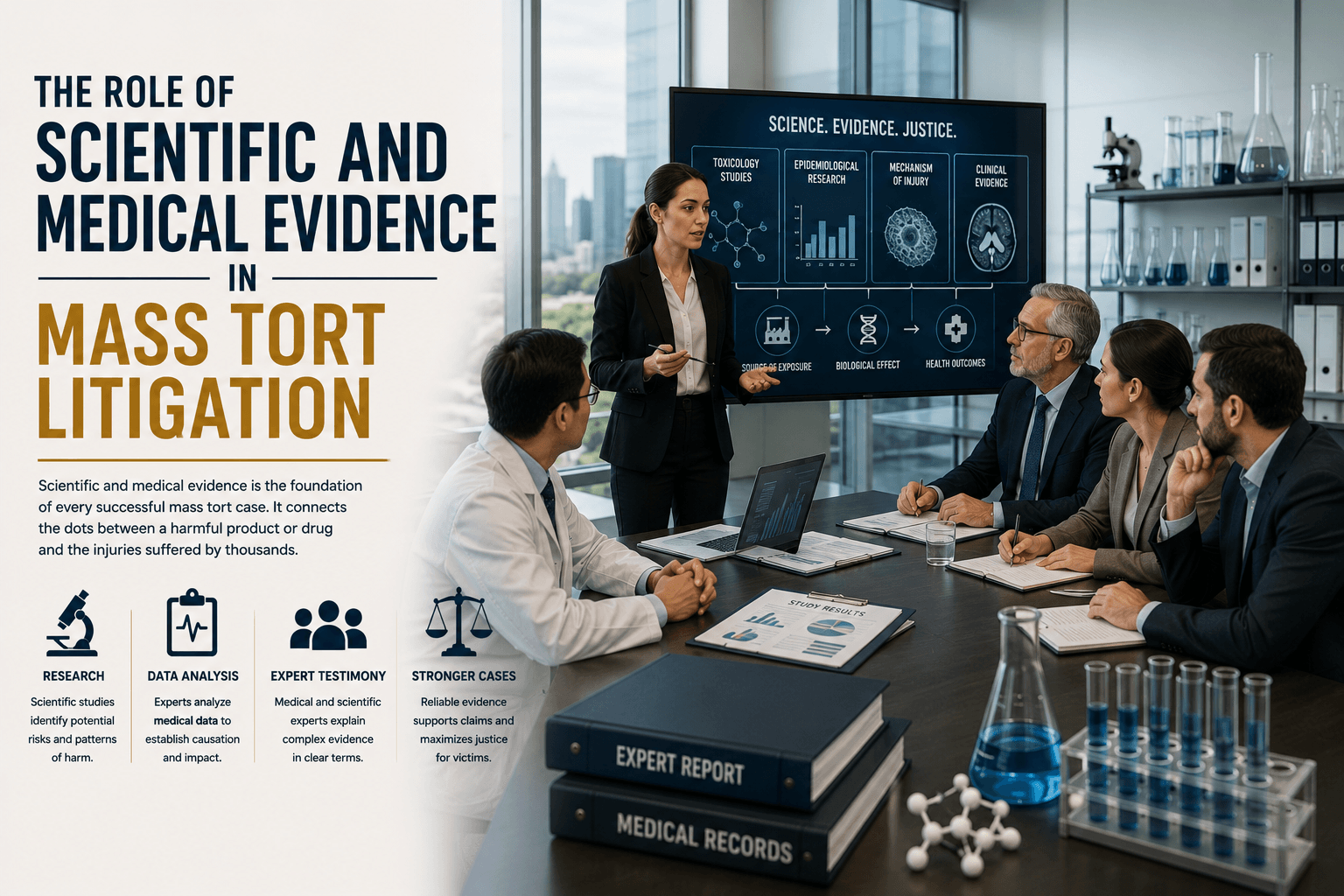

Mass tort litigation often involves some of the most complex legal disputes in modern civil law. Unlike many traditional lawsuits, these cases frequently require courts to evaluate not only legal arguments but also extensive scientific research, medical records, engineering reports, toxicology findings, and expert testimony. Whether a case involves a prescription medication, medical device, environmental contamination, defective consumer product, or industrial exposure, scientific and medical evidence often forms the foundation of the litigation.
Because mass tort cases typically involve numerous plaintiffs alleging similar injuries from a common source, courts must determine whether reliable evidence supports the claimed connection between the product, substance, or event and the alleged harm. This process requires careful examination of technical information that may extend far beyond ordinary legal issues.
Understanding the role of scientific and medical evidence helps explain why mass tort litigation often takes years to resolve and why expert analysis is essential throughout the legal process.
Why Evidence Is So Important
Every legal claim requires evidence.
In mass tort litigation, however, the evidence often extends beyond eyewitness testimony or written documents. Courts frequently evaluate highly specialized scientific and medical information to determine whether a plaintiff’s injuries may reasonably be connected to the product or event at issue.
Reliable evidence helps courts:
- Evaluate alleged injuries
- Understand complex medical conditions
- Assess product safety
- Examine scientific research
- Determine whether claims have factual support
Without credible evidence, complex litigation becomes much more difficult to resolve fairly.
Understanding Causation
One of the central questions in many mass tort cases is causation.
Causation generally refers to whether the alleged product, medication, device, or environmental exposure could reasonably have contributed to the plaintiff’s injury.
This often involves two separate considerations:
General Causation
General causation examines whether scientific evidence suggests that a product or substance is capable of causing a particular type of injury.
For example:
- Can prolonged exposure to a certain chemical contribute to a specific illness?
- Can a medical device malfunction create identifiable health complications?
- Can a medication produce certain side effects?
Scientific studies frequently play a major role in answering these questions.
Specific Causation
Specific causation focuses on the individual plaintiff.
It considers whether the product or exposure likely contributed to that person’s injuries after reviewing:
- Medical history
- Treatment records
- Timing of symptoms
- Alternative explanations
- Diagnostic testing
Each plaintiff’s circumstances are evaluated individually.
Types of Scientific Evidence
Mass tort litigation may involve numerous forms of scientific evidence.
Common examples include:
- Clinical trials
- Laboratory testing
- Engineering reports
- Toxicology studies
- Epidemiological research
- Product testing
- Safety evaluations
- Regulatory findings
Each type of evidence provides different information regarding the alleged risks associated with a product or exposure.
Medical Records
Medical documentation remains one of the most important forms of evidence.
Common records include:
- Hospital records
- Physician notes
- Diagnostic imaging
- Laboratory results
- Surgical reports
- Prescription history
- Rehabilitation records
These documents help establish:
- Diagnosis
- Treatment
- Injury severity
- Medical timeline
- Recovery progress
Well-organized medical records often strengthen the factual foundation of an individual claim.
Epidemiological Studies
Epidemiology is the study of how diseases and health conditions affect populations.
In mass tort litigation, epidemiological research may help determine whether certain health outcomes occur more frequently among people exposed to a particular product or substance.
These studies may examine:
- Population health trends
- Exposure patterns
- Disease incidence
- Risk factors
- Long-term outcomes
While epidemiological evidence is valuable, it is usually considered alongside other scientific information rather than in isolation.
Toxicology and Exposure Analysis
Some mass tort cases involve allegations of exposure to chemicals, industrial substances, or environmental contaminants.
Toxicology experts may evaluate:
- Chemical composition
- Levels of exposure
- Biological effects
- Duration of exposure
- Dose-response relationships
Understanding the nature and extent of exposure helps courts assess scientific questions relating to alleged injuries.
Product Testing and Engineering Evidence
When litigation involves consumer products, medical devices, or vehicles, engineering evidence often becomes important.
Experts may review:
- Product design
- Manufacturing processes
- Quality control procedures
- Failure analysis
- Safety testing
- Performance evaluations
Engineering reports can help explain whether a product functioned as intended or whether design or manufacturing issues may have contributed to the alleged harm.
The Role of Expert Witnesses
Because many scientific issues are highly technical, courts frequently rely on expert witnesses.
Experts may include:
- Physicians
- Epidemiologists
- Toxicologists
- Biomedical engineers
- Pharmacologists
- Industrial hygienists
- Statisticians
Their role is to explain complex scientific information in a manner that assists judges and juries in understanding the evidence.
Expert witnesses do not decide the outcome of the case. Instead, they provide specialized knowledge to help the court evaluate technical issues.
Regulatory Information
Government regulatory agencies often collect safety information relating to products, medications, and medical devices.
Examples of regulatory materials may include:
- Safety communications
- Product recalls
- Inspection reports
- Adverse event reporting systems
- Manufacturing reviews
Depending on the jurisdiction and the specific case, regulatory information may become one component of the overall evidence presented during litigation.
Electronic Evidence in Modern Litigation
Technology has transformed how scientific evidence is collected and reviewed.
Digital evidence may include:
- Electronic medical records
- Digital imaging
- Laboratory databases
- Product tracking systems
- Manufacturing records
- Electronic communications
These resources often improve the organization and accessibility of evidence in large-scale litigation.
Challenges in Evaluating Scientific Evidence
Scientific evidence is not always straightforward.
Courts may need to evaluate:
- Conflicting expert opinions
- Newly published research
- Changing medical knowledge
- Incomplete data
- Complex statistical analyses
Judges often determine whether proposed expert testimony meets the legal standards required for admissibility before it is presented during legal proceedings.
Why Individual Medical Evidence Still Matters
Although mass tort litigation involves numerous plaintiffs, each person’s medical circumstances remain unique.
Individual records help establish:
- Personal medical history
- Extent of injuries
- Treatment received
- Recovery progress
- Long-term health effects
This individualized evaluation distinguishes mass tort litigation from legal proceedings where claims are resolved collectively.
Common Misconceptions
Myth: Scientific Evidence Alone Determines Every Case.
Scientific research is important, but courts typically consider multiple forms of evidence together, including medical records, expert testimony, and factual documentation.
Myth: Every Plaintiff Must Have Identical Medical Conditions.
Mass tort litigation often includes plaintiffs with varying degrees of injury and different treatment histories.
Each claim is evaluated individually.
Myth: Expert Witnesses Decide the Outcome.
Expert witnesses explain technical subjects, but judges and juries remain responsible for evaluating all admissible evidence and reaching legal decisions.
The Future of Scientific Evidence in Mass Tort Litigation
Rapid advances in medicine, biotechnology, artificial intelligence, and data analytics continue transforming complex litigation.
Future mass tort cases may increasingly rely on:
- Genomic research
- Artificial intelligence-assisted medical analysis
- Digital pathology
- Real-time health monitoring
- Wearable medical devices
- Large healthcare databases
These innovations may improve the accuracy of scientific investigations while helping courts evaluate increasingly sophisticated evidence.
At the same time, legal systems will continue balancing scientific innovation with procedural fairness to ensure reliable evidence remains the cornerstone of complex litigation.
Conclusion
Scientific and medical evidence plays a central role in mass tort litigation by helping courts evaluate whether products, medications, environmental exposures, or other alleged hazards may be connected to individual injuries. From medical records and epidemiological research to engineering analysis and expert testimony, multiple forms of evidence contribute to the careful examination of complex legal disputes.
Although every case presents unique factual and scientific challenges, reliable evidence remains essential for ensuring that mass tort litigation is resolved fairly, consistently, and based on objective information. As science and technology continue advancing, their role in complex civil litigation will only become more significant, supporting more informed legal decision-making in the years ahead.
Frequently Asked Questions
Why is scientific evidence important in mass tort litigation?
Scientific evidence helps courts evaluate whether a product, medication, or exposure may reasonably be connected to the injuries alleged by plaintiffs.
What is the difference between general causation and specific causation?
General causation examines whether something is capable of causing a particular injury, while specific causation considers whether it likely contributed to an individual plaintiff’s condition.
What types of experts commonly participate in mass tort cases?
Experts may include physicians, toxicologists, epidemiologists, biomedical engineers, pharmacologists, statisticians, and other specialists depending on the issues involved.
Why are medical records important?
Medical records document diagnoses, treatment history, injury severity, recovery, and timelines, making them essential evidence in evaluating individual claims.
Does every plaintiff need the same scientific evidence?
No. While many plaintiffs rely on common scientific research, each claim is typically supported by individualized medical records and evidence reflecting that person’s specific circumstances.