
Truck accident liability is often far more complex than collisions involving passenger vehicles. While a typical car accident may involve only two drivers and their insurance companies, commercial truck accidents frequently involve multiple businesses, contractors, insurers, and other parties connected to the operation of the vehicle. Determining liability requires a careful investigation into how the accident occurred and whether one or more parties may have contributed to the events leading to the collision.
Commercial trucking is governed by extensive federal and state regulations covering driver qualifications, vehicle maintenance, cargo securement, operating hours, inspections, and safety procedures. Because several organizations may share responsibility for different aspects of a trucking operation, liability may extend beyond the truck driver alone.
Understanding who may be held liable in a truck accident case helps explain why these claims often require detailed investigations and extensive evidence.
What Is Liability in a Truck Accident Case?
Liability refers to legal responsibility for an accident and any resulting damages.
In a truck accident case, investigators generally seek to determine:
- How the collision occurred
- Whether negligence or another legal basis for responsibility exists
- Which individuals or businesses contributed to the accident
- Whether more than one party shares responsibility
Liability is determined according to the facts of the case and the applicable laws of the jurisdiction.
Why Truck Accident Liability Is More Complex
Commercial trucking operations involve many moving parts.
A single shipment may involve:
- A truck driver
- A trucking company
- A vehicle owner
- A trailer owner
- A freight broker
- A cargo loading company
- A maintenance contractor
- Equipment manufacturers
Each party may have separate responsibilities, making liability investigations more detailed than those involving ordinary passenger vehicles.
The Truck Driver
The truck driver is often the first party considered during an accident investigation.
Driver-related issues may include:
- Distracted driving
- Fatigue
- Speeding
- Impaired driving
- Failure to obey traffic laws
- Improper lane changes
- Unsafe following distance
- Failure to inspect the vehicle
Investigators examine whether the driver acted reasonably under the circumstances.
The Trucking Company
The trucking company may also bear responsibility depending on its role in the operation of the commercial vehicle.
Potential issues may involve:
- Hiring practices
- Driver supervision
- Training programs
- Scheduling practices
- Hours-of-service compliance
- Vehicle maintenance
- Safety policies
- Recordkeeping
Companies are generally expected to maintain safe operations and comply with applicable transportation regulations.
The Owner of the Truck or Trailer
In some situations, the truck or trailer may be owned by a different company than the one employing the driver.
Owners may have responsibilities relating to:
- Vehicle inspections
- Maintenance
- Repairs
- Equipment replacement
- Safe operating condition
Ownership arrangements vary throughout the trucking industry.
Cargo Loading Companies
Improperly loaded cargo can significantly affect vehicle stability.
Cargo-related issues may include:
- Overloading
- Uneven weight distribution
- Improper securement
- Hazardous material handling
- Load shifts during transportation
Businesses responsible for loading cargo may become part of a liability investigation when cargo contributes to an accident.
Maintenance and Repair Providers
Commercial vehicles require regular inspection and maintenance.
Outside maintenance providers may perform:
- Brake repairs
- Tire replacement
- Steering repairs
- Suspension maintenance
- Electrical work
- Safety inspections
If maintenance work is allegedly performed improperly or critical repairs are overlooked, investigators may evaluate whether maintenance contributed to the accident.
Vehicle and Parts Manufacturers
Occasionally, a truck accident may involve an alleged defect in the vehicle or one of its components.
Examples include:
- Brake systems
- Tires
- Steering components
- Coupling devices
- Lighting systems
- Electronic safety systems
Product-related issues are evaluated under legal principles that differ from ordinary negligence claims.
Freight Brokers and Logistics Companies
Freight brokers help coordinate transportation between shippers and trucking companies.
Depending on the circumstances, investigators may examine issues such as:
- Carrier selection
- Contractual responsibilities
- Operational oversight
- Regulatory compliance
The specific legal responsibilities of freight brokers vary depending on applicable law and the facts of each case.
Government Entities
In limited situations, roadway design or maintenance may become relevant.
Potential issues include:
- Poor road maintenance
- Inadequate signage
- Unsafe construction zones
- Defective traffic signals
Claims involving government entities often follow special legal procedures and deadlines established by law.
Other Motorists
Not every truck accident is caused by the commercial vehicle.
Passenger vehicle drivers may contribute through:
- Unsafe lane changes
- Speeding
- Distracted driving
- Following too closely
- Failure to yield
- Sudden braking
Investigators evaluate the actions of all drivers involved in the collision.
How Liability Is Determined
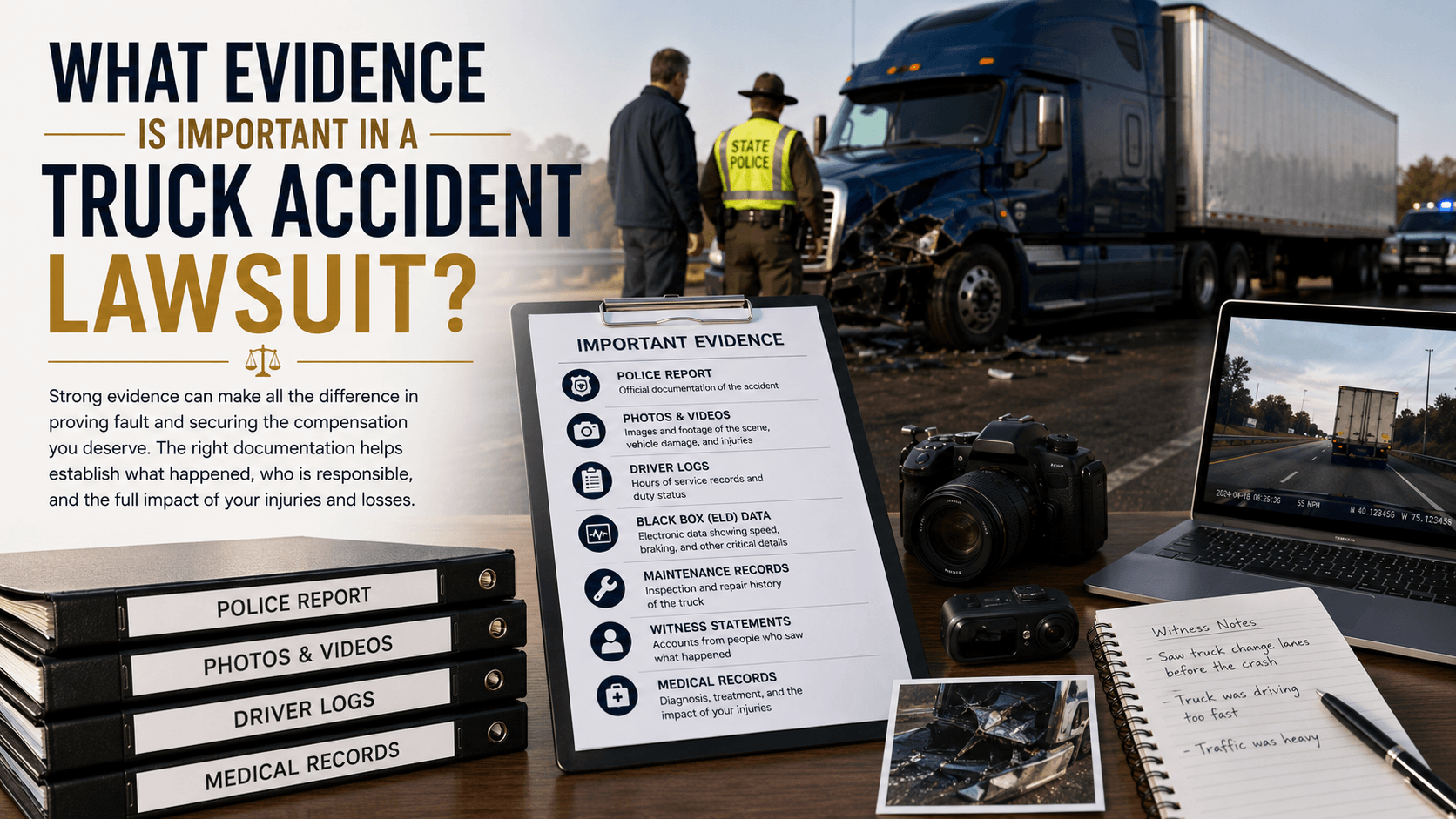
Truck accident investigations rely on extensive evidence.
Important evidence may include:
- Police reports
- Driver logbooks
- Electronic logging device (ELD) records
- Vehicle maintenance records
- Inspection reports
- Dash camera footage
- GPS tracking data
- Witness statements
- Accident reconstruction reports
- Electronic control module (“black box”) data
Each piece of evidence helps investigators understand how the accident occurred and identify potentially responsible parties.
Comparative Negligence
Some truck accident cases involve shared responsibility.
Depending on the applicable law, investigators may evaluate:
- The truck driver’s conduct
- Actions of other motorists
- Road conditions
- Equipment issues
- Cargo loading practices
Comparative negligence rules differ by jurisdiction and may affect how responsibility is allocated among the parties.
Insurance Considerations
Truck accident claims often involve multiple insurance policies.
Coverage may include:
- Commercial auto liability insurance
- Cargo insurance
- Trailer insurance
- Employer liability coverage
- Umbrella policies
- Excess liability insurance
Understanding the available insurance coverage is often an important part of resolving commercial truck accident claims.
Common Misconceptions About Truck Accident Liability
Myth: The Truck Driver Is Always the Only Responsible Party
Truck accident investigations frequently examine the conduct of trucking companies, maintenance providers, cargo loaders, manufacturers, and other parties in addition to the driver.
Myth: Larger Vehicles Are Automatically Liable
The size of a commercial truck does not determine legal responsibility. Liability depends on the available evidence and applicable legal standards.
Myth: Every Truck Accident Involves Multiple Defendants
Some truck accidents involve only one responsible party, while others involve several. Each case depends on its unique facts.
Myth: Liability Is Determined Immediately
Establishing liability often requires detailed investigation, document review, expert analysis, and evaluation of applicable regulations.
Technology and Modern Liability Investigations
Technology has greatly improved truck accident investigations.
Modern tools include:
- Electronic logging devices
- GPS fleet tracking
- Event data recorders
- Artificial intelligence-assisted accident analysis
- Drone accident scene mapping
- Digital maintenance records
- Advanced accident reconstruction software
- Fleet telematics
These technologies provide investigators with more accurate and detailed information about commercial vehicle operations.
Why Thorough Investigations Matter
Identifying all potentially responsible parties helps ensure that accident investigations are complete and based on objective evidence.
Comprehensive investigations typically involve:
- Reviewing commercial records
- Inspecting vehicles
- Examining maintenance histories
- Interviewing witnesses
- Evaluating regulatory compliance
- Consulting technical experts
A careful investigation promotes a more accurate understanding of how the collision occurred.
Conclusion
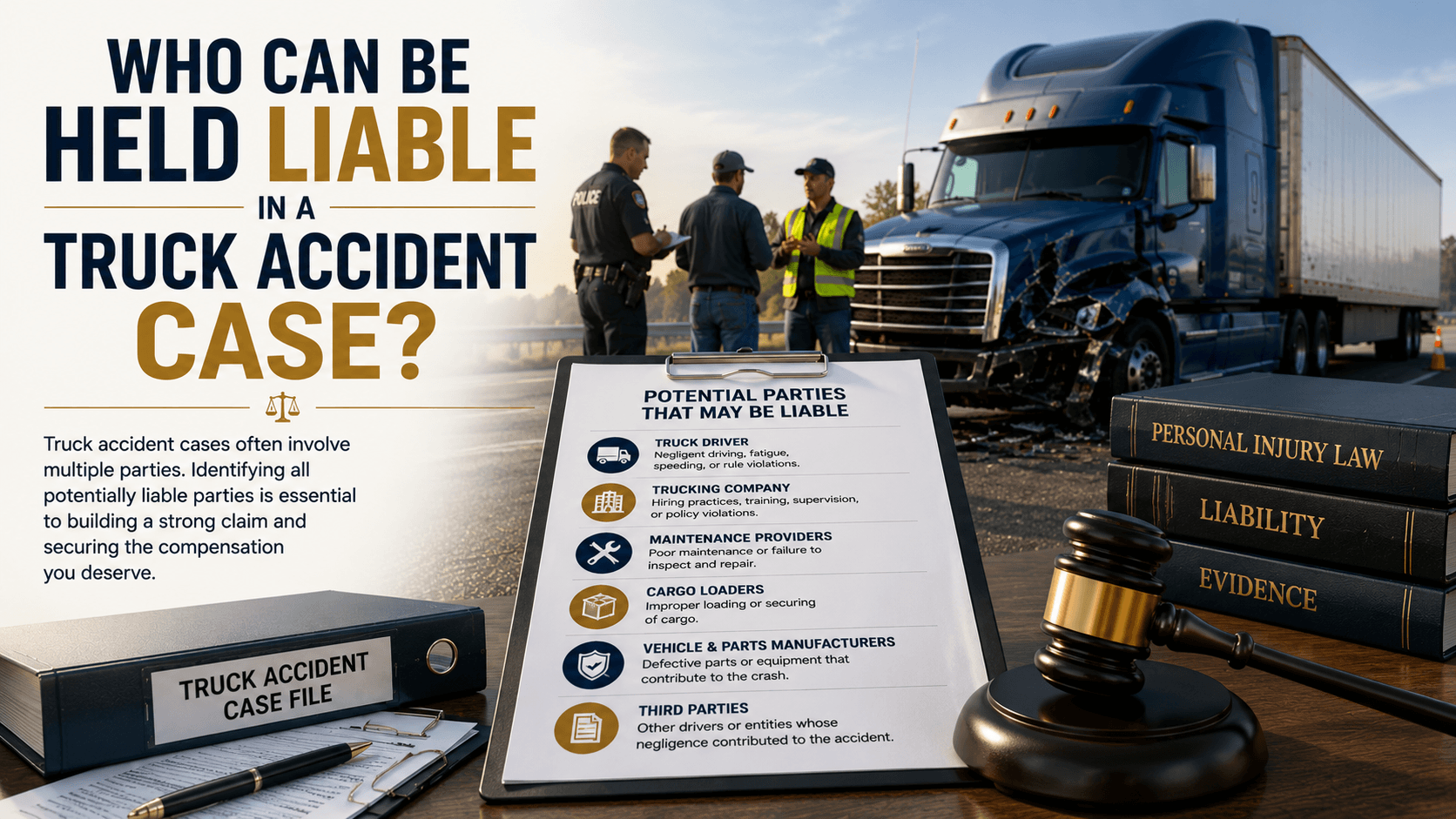
Truck accident liability is often more complex than liability in ordinary motor vehicle accidents because multiple individuals and businesses may contribute to the operation and safety of a commercial truck. Depending on the facts, responsibility may involve the truck driver, trucking company, vehicle owner, maintenance provider, cargo loader, manufacturer, freight broker, government entity, or another motorist.
Determining liability requires careful analysis of evidence, compliance with transportation regulations, and a thorough understanding of the relationships among the parties involved. As commercial trucking technology continues to evolve, modern investigations increasingly rely on electronic records and advanced forensic tools to help establish responsibility and resolve claims fairly.
Frequently Asked Questions
Who can be held liable in a truck accident?
Depending on the circumstances, liability may involve the truck driver, trucking company, vehicle owner, cargo loading company, maintenance provider, manufacturer, freight broker, government entity, or another motorist.
Is the trucking company always responsible for a truck accident?
Not necessarily. Responsibility depends on the facts of the accident, the company’s role, applicable regulations, and the available evidence.
Why do truck accident cases involve multiple parties?
Commercial trucking operations often involve several businesses responsible for different aspects of transportation, including driving, maintenance, cargo loading, vehicle ownership, and logistics.
What evidence helps determine truck accident liability?
Important evidence includes police reports, electronic logging device records, maintenance records, inspection reports, witness statements, GPS data, black box information, photographs, and expert analyses.
Can more than one party share responsibility for a truck accident?
Yes. Depending on the facts and applicable law, multiple parties may share liability if their actions contributed to the accident.