
Employment is one of the most important aspects of modern life. It provides financial stability, career development, and opportunities for personal growth. At the same time, the workplace brings together employers and employees with different responsibilities, expectations, and legal obligations. Employment law exists to create a structured legal framework that helps balance these relationships while promoting fairness, safety, and accountability.
Although employment laws differ between countries, many of their underlying principles are remarkably similar. Most legal systems establish rules governing hiring practices, wages, working hours, workplace safety, discrimination, employee benefits, privacy, and the resolution of workplace disputes.
Understanding these legal principles benefits both employees and employers. Employees gain a better understanding of their workplace rights, while employers can better appreciate the responsibilities that help maintain lawful and productive workplaces.
This guide provides an overview of employment law, explaining its purpose, major areas of regulation, and why it continues to play an essential role in today’s evolving workforce.
What Is Employment Law?
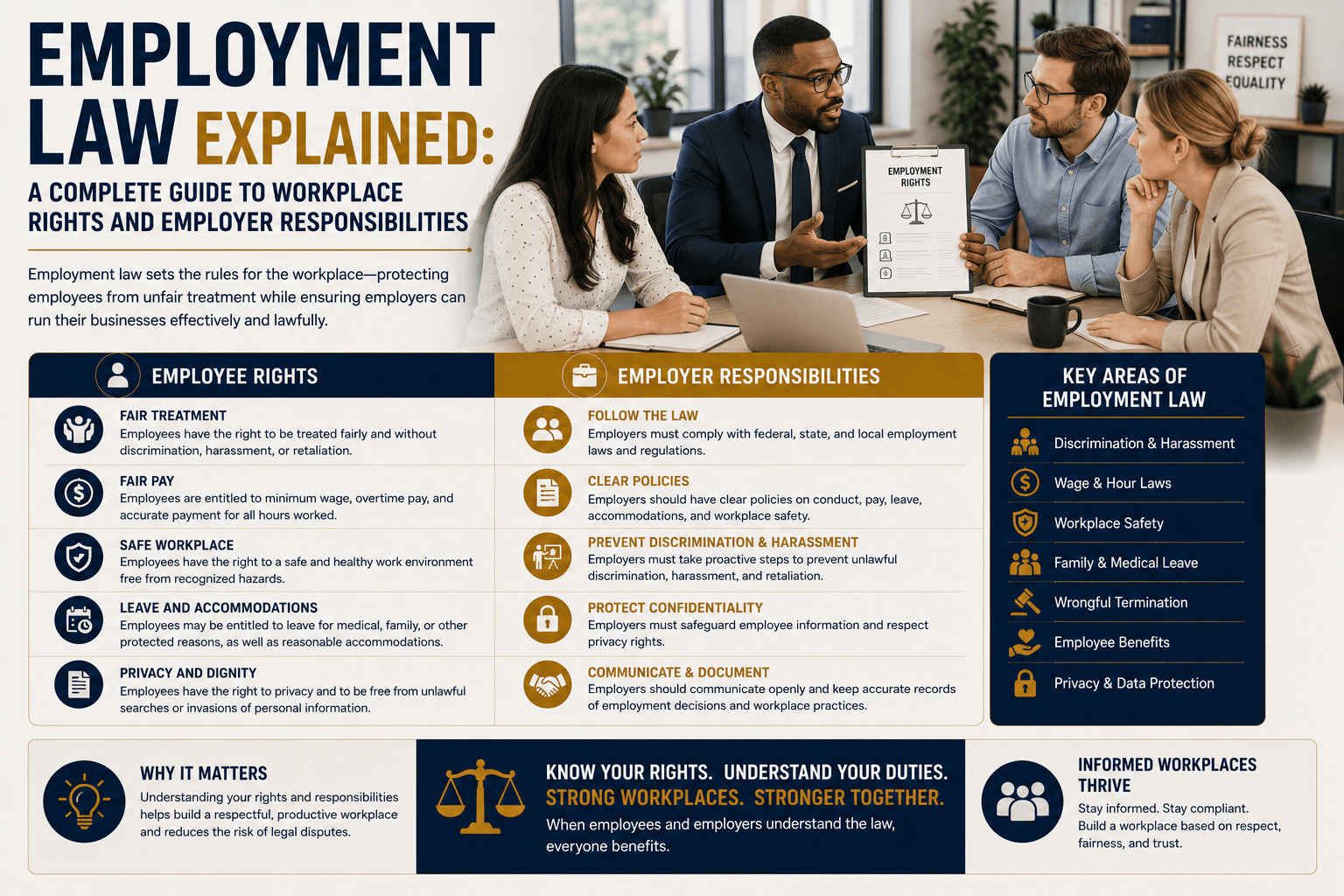
Employment law is the body of laws, regulations, and legal principles that govern the relationship between employers and employees.
Its purpose is to establish fair standards for workplace practices while protecting the legal rights of everyone involved.
Employment law commonly addresses areas such as:
- Recruitment and hiring
- Employment contracts
- Wages and compensation
- Working hours
- Workplace safety
- Equal employment opportunities
- Employee leave
- Privacy
- Workplace discipline
- Termination of employment
Together, these legal rules help define how employment relationships begin, operate, and conclude.
Why Employment Law Matters
Employment law serves several important purposes.
It helps:
- Protect employees from unlawful treatment.
- Establish clear workplace expectations.
- Promote safe working environments.
- Encourage equal opportunities.
- Support fair dispute resolution.
- Provide employers with legal guidance.
- Improve workplace stability and trust.
Strong employment practices often benefit organizations as much as employees by reducing disputes and improving workplace morale.
Employment Relationships
An employment relationship generally begins when an employer hires an individual to perform work under agreed terms and conditions.
The relationship may be:
- Full-time
- Part-time
- Temporary
- Seasonal
- Fixed-term
- Casual
- Remote
- Hybrid
Regardless of the working arrangement, legal obligations often apply to both employers and employees.
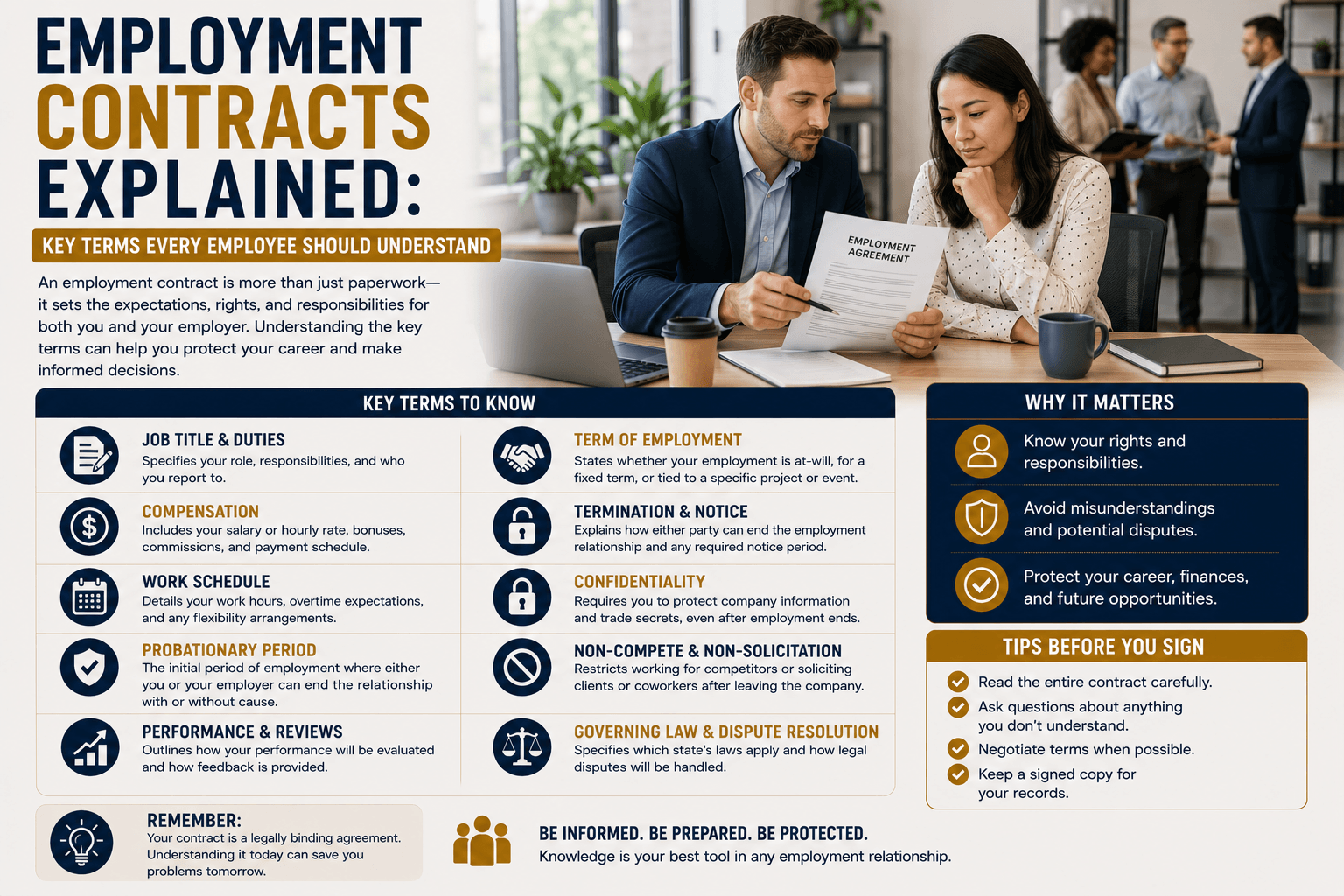
Employment Contracts
Employment contracts establish the terms of the working relationship.
Although the format varies, contracts commonly include:
- Job title
- Duties and responsibilities
- Working hours
- Salary or wages
- Benefits
- Leave entitlements
- Confidentiality provisions
- Notice requirements
- Termination procedures
A clearly written contract helps reduce misunderstandings by setting expectations from the beginning of employment.
Recruitment and Hiring
Employment law often regulates hiring practices to promote fairness and equal opportunity.
Employers are generally expected to make hiring decisions based on legitimate job-related factors rather than unlawful discrimination.
Recruitment practices may include:
- Job advertisements
- Interviews
- Background checks (where permitted)
- Reference checks
- Skills assessments
Transparent hiring procedures contribute to more inclusive workplaces and support merit-based employment decisions.
Wages and Working Hours
Most employment laws establish standards regarding employee compensation.
These standards may address:
- Minimum wage requirements
- Overtime pay
- Pay frequency
- Wage deductions
- Rest periods
- Meal breaks
- Maximum working hours
The exact rules vary by jurisdiction, industry, and employment agreement, but the overall goal is to encourage fair compensation for work performed.
Workplace Health and Safety
A safe workplace benefits everyone.
Employment laws frequently require employers to take reasonable steps to reduce workplace hazards and protect employee wellbeing.
Safety measures may include:
- Risk assessments
- Safety training
- Protective equipment
- Emergency procedures
- Incident reporting
- Hazard identification
Employees also play an important role by following safety procedures and reporting unsafe conditions when appropriate.
Equal Employment Opportunities
Equal treatment is a central principle of modern employment law.
Many legal systems prohibit discrimination based on protected characteristics such as:
- Age
- Disability
- Race or ethnicity
- Religion
- Sex
- Pregnancy
- National origin
- Other protected characteristics established by law
These protections help create workplaces where employment decisions are based on qualifications and performance rather than unlawful bias.
Workplace Harassment
Employment law also addresses workplace harassment.
Harassment may involve unwanted behavior that creates an intimidating, hostile, or offensive work environment.
Examples can include:
- Verbal abuse
- Offensive comments
- Repeated intimidation
- Sexual harassment
- Bullying that violates applicable legal standards
Many employers establish reporting procedures to address workplace concerns promptly and fairly.
Employee Leave
Employees may be entitled to various forms of leave depending on applicable laws and employment agreements.
Examples include:
- Annual leave
- Sick leave
- Family leave
- Parental leave
- Bereavement leave
- Military leave (where applicable)
- Jury service leave (where applicable)
Leave policies help employees manage important life events while maintaining their employment relationship.
Privacy in the Workplace
Technology has changed how organizations collect, store, and use employee information.
Employment law increasingly addresses workplace privacy issues involving:
- Personnel records
- Electronic communications
- Monitoring systems
- Data protection
- Confidential information
Employers often have legitimate business reasons for collecting information, but they generally must balance those interests with applicable privacy laws.
Performance Management
Employers commonly evaluate employee performance to support professional development and organizational goals.
Performance management may include:
- Performance reviews
- Training opportunities
- Goal setting
- Coaching
- Corrective action where appropriate
Clear communication and consistent procedures often contribute to fairer workplace outcomes.
Ending the Employment Relationship
Employment relationships may end for many reasons, including:
- Resignation
- Retirement
- Redundancy
- Expiration of a fixed-term contract
- Business restructuring
- Performance-related issues
- Misconduct
Employment law often establishes rules governing notice periods, final compensation, documentation, and other obligations associated with ending employment.
Resolving Workplace Disputes
Despite clear workplace policies, disagreements sometimes occur.
Common employment disputes involve:
- Wages
- Working conditions
- Contract interpretation
- Discrimination allegations
- Harassment concerns
- Leave entitlements
- Termination issues
Many disputes can be addressed through internal workplace procedures, mediation, or other dispute resolution methods before formal legal action becomes necessary.
The Impact of Technology on Employment Law
The workplace continues to evolve rapidly.
Remote work, artificial intelligence, digital monitoring, cloud-based collaboration, and flexible employment models have introduced new legal questions regarding:
- Employee privacy
- Working hours
- Cross-border employment
- Data security
- Workplace surveillance
- Digital communication
Employment law continues adapting to ensure legal protections remain effective in modern working environments.
Responsibilities of Employees
While employment law provides important legal protections, employees also have responsibilities.
These commonly include:
- Performing assigned duties.
- Following workplace policies.
- Respecting colleagues.
- Maintaining confidentiality.
- Complying with health and safety requirements.
- Reporting concerns appropriately.
A positive employment relationship depends on mutual respect and cooperation.
Responsibilities of Employers
Employers also have significant responsibilities.
These often include:
- Providing a safe workplace.
- Paying employees according to applicable laws.
- Preventing unlawful discrimination.
- Maintaining accurate employment records.
- Respecting employee rights.
- Following contractual obligations.
- Addressing workplace concerns fairly.
Strong workplace leadership often promotes higher employee satisfaction and organizational success.
Looking Toward the Future
Employment law will continue evolving alongside technological innovation, demographic changes, and shifting workplace expectations.
Issues such as remote work, artificial intelligence, flexible scheduling, gig economy employment, cybersecurity, and employee wellbeing are likely to remain important areas of legal development.
Organizations that proactively adapt to these changes while respecting employee rights are often better positioned to build resilient and productive workplaces.
Likewise, employees who understand their legal rights and workplace responsibilities are better equipped to navigate modern employment relationships with confidence.
Conclusion
Employment law provides the legal foundation for fair, safe, and productive workplaces. By establishing rules governing recruitment, contracts, wages, workplace safety, discrimination, employee leave, privacy, and dispute resolution, employment law helps balance the rights and responsibilities of both employers and employees.
Although specific legal requirements vary between jurisdictions, the underlying goals remain consistent: promoting fairness, protecting workplace rights, encouraging accountability, and supporting positive employment relationships. As workplaces continue to evolve through technological advances and changing workforce expectations, employment law will remain an essential part of maintaining trust, stability, and legal compliance across a wide range of industries.
Frequently Asked Questions
What is employment law?
Employment law is the collection of laws and regulations that govern the relationship between employers and employees, including workplace rights, employer responsibilities, contracts, wages, safety, and dispute resolution.
Why is employment law important?
Employment law helps protect employee rights, establish employer responsibilities, promote safe workplaces, and provide legal standards for resolving workplace disputes.
Does employment law apply to every workplace?
Employment laws generally apply to most workplaces, although the specific rules vary depending on the country, employment arrangement, industry, and applicable legislation.
What issues are commonly covered by employment law?
Employment law commonly addresses hiring, employment contracts, wages, working hours, discrimination, workplace safety, employee leave, privacy, discipline, and termination.
How is employment law changing?
Employment law continues evolving to address remote work, artificial intelligence, digital privacy, cybersecurity, flexible work arrangements, and other modern workplace developments.