
Losing a job can be one of life’s most stressful experiences. Beyond the immediate financial impact, termination of employment can affect professional reputation, emotional wellbeing, career progression, and long-term financial security. While many employment relationships end lawfully through resignation, retirement, redundancy, or legitimate business decisions, there are situations where an employee may question whether their dismissal was lawful.
This is where the concept of wrongful termination becomes important.
Although the legal definition of wrongful termination varies across jurisdictions, the general principle is similar: employers must comply with applicable employment laws, contractual obligations, and established workplace procedures when ending an employment relationship. When those legal requirements are not followed, employees may have legal options depending on the circumstances and the laws that apply.
Understanding what wrongful termination means—and what it does not mean—can help both employees and employers better understand their workplace rights and responsibilities.
This guide explains the fundamentals of wrongful termination, common situations that may lead to legal disputes, and practical steps individuals can take when employment comes to an unexpected end.
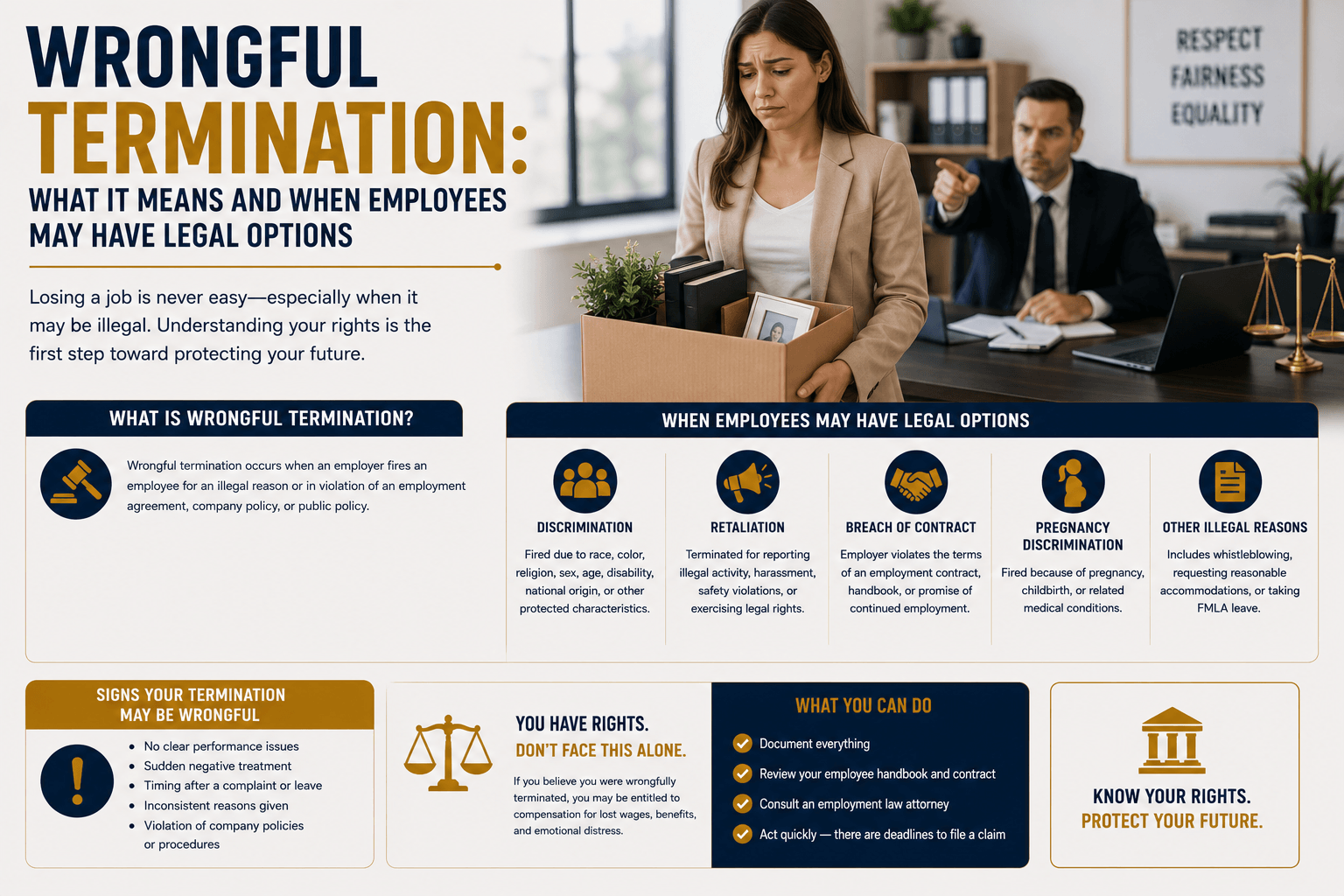
What Is Wrongful Termination?
Wrongful termination refers to a situation in which an employee believes their employment ended in violation of employment laws, contractual obligations, or legally protected rights.
Depending on the country or legal system, wrongful termination may also be referred to as:
- Wrongful dismissal
- Unlawful dismissal
- Unfair dismissal
- Illegal termination
Although these terms sometimes have different legal meanings in specific jurisdictions, they all generally involve allegations that an employer failed to follow applicable legal requirements when ending employment.
Lawful vs. Wrongful Termination
Not every dismissal is unlawful.
Employers may legitimately terminate employment for various business or performance-related reasons, provided they comply with applicable laws and contractual obligations.
Examples of lawful termination may include:
- Business restructuring
- Position redundancy
- Poor job performance
- Serious workplace misconduct
- Repeated policy violations
- Expiration of a fixed-term contract
- Voluntary resignation
- Retirement
Wrongful termination concerns how and why the employment relationship ended rather than simply the fact that it ended.
Common Situations That May Lead to Wrongful Termination Claims
While every case depends on its specific facts and applicable laws, several situations commonly give rise to legal disputes.
1. Discrimination
Many countries prohibit employers from terminating employees because of protected characteristics such as:
- Age
- Disability
- Race or ethnicity
- Religion
- Sex
- Pregnancy
- National origin
- Other legally protected characteristics
Employment decisions should generally be based on legitimate workplace factors rather than unlawful discrimination.
2. Retaliation
Employees are often protected from retaliation for exercising certain legal rights.
Examples may include:
- Reporting workplace safety concerns
- Filing discrimination complaints
- Participating in workplace investigations
- Reporting unlawful conduct
- Requesting legally protected leave
- Cooperating with government authorities
If termination occurs because an employee exercised a protected legal right, the dismissal may become subject to legal review.
3. Breach of Employment Contract
Many employment contracts establish procedures regarding:
- Notice periods
- Grounds for dismissal
- Performance reviews
- Disciplinary procedures
- Severance obligations
Failure to comply with contractual obligations may contribute to wrongful termination disputes.
4. Violation of Public Policy
Some legal systems prohibit employers from dismissing employees for actions that serve important public interests.
Examples may include:
- Serving on a jury where required by law
- Reporting criminal activity
- Refusing to participate in illegal conduct
- Exercising certain statutory rights
Public policy protections vary considerably between jurisdictions.
Signs That May Raise Questions About a Termination
Although every situation is different, certain circumstances may warrant closer examination.
For example:
- The employer failed to follow its own disciplinary procedures.
- The stated reason for dismissal changed over time.
- The termination occurred shortly after a protected complaint.
- Similar employees were treated differently.
- Important contractual obligations were ignored.
- There is evidence suggesting discriminatory treatment.
These factors alone do not automatically establish wrongful termination, but they may become relevant during a legal review.
The Importance of Documentation
Documentation often plays an important role in employment disputes.
Useful records may include:
- Employment contracts
- Offer letters
- Performance evaluations
- Emails
- Written warnings
- Workplace policies
- Pay records
- Termination letters
Maintaining organized records can help clarify the sequence of events if questions later arise regarding the circumstances of termination.
Employer Responsibilities During Termination
Responsible employers generally seek to ensure that employment decisions are:
- Consistent
- Well documented
- Non-discriminatory
- Supported by legitimate business reasons
- Conducted according to applicable laws
- Consistent with workplace policies
Clear communication throughout the termination process may reduce misunderstandings and workplace conflict.
Employee Responsibilities
Employees also have responsibilities throughout the employment relationship.
These may include:
- Following workplace policies
- Performing assigned duties
- Respecting workplace rules
- Maintaining professionalism
- Protecting confidential information
Understanding these responsibilities helps create balanced workplace relationships while reducing unnecessary disputes.
What Should Employees Do After a Termination?
Receiving notice that employment has ended can be overwhelming.
Practical steps may include:
- Carefully reviewing the termination letter.
- Requesting copies of employment records where appropriate.
- Keeping copies of relevant workplace communications.
- Reviewing the employment contract.
- Recording important dates while events remain fresh.
- Remaining professional during the transition.
Taking organized steps early can help preserve important information.
Common Misconceptions About Wrongful Termination
Several myths often create confusion.
Myth 1: Every Unfair Decision Is Illegal
A workplace decision may feel unfair without necessarily violating employment law.
Legal claims generally depend on whether applicable laws or contractual obligations were breached.
Myth 2: Employers Can Never Dismiss Employees Without Warning
This depends on the employment relationship, applicable laws, employment contracts, and the circumstances surrounding the dismissal.
Some situations may justify immediate termination, while others require notice or progressive discipline.
Myth 3: Poor Performance Can Never Lead to Lawful Termination
Performance-related dismissals may be lawful when employers follow applicable legal requirements and workplace procedures.
Preventing Wrongful Termination Disputes
Many workplace disputes can be reduced through proactive management.
Employers may benefit from:
- Clear workplace policies
- Consistent disciplinary procedures
- Fair investigations
- Accurate documentation
- Supervisor training
- Transparent communication
Employees can also contribute by:
- Understanding workplace policies.
- Maintaining professional communication.
- Reporting concerns through appropriate channels.
- Keeping personal employment records.
Prevention often proves more effective than resolving disputes after they occur.
The Impact of Remote Work
Modern workplaces have introduced new employment challenges.
Remote and hybrid work arrangements have raised questions involving:
- Performance monitoring
- Digital communications
- Flexible scheduling
- Cross-border employment
- Electronic documentation
As employment practices evolve, termination decisions increasingly rely on digital records and virtual workplace interactions.
Looking Toward the Future
Employment law continues adapting to changing workforce expectations.
Artificial intelligence, automation, remote work, digital surveillance, and global employment models are reshaping how employers manage performance, discipline, and termination decisions.
Future employment disputes may increasingly involve electronic evidence, workplace algorithms, and digital employment records.
Organizations that prioritize fairness, transparency, and consistent workplace procedures are often better positioned to reduce legal risk while maintaining positive workplace cultures.
Conclusion
Wrongful termination is a complex area of employment law that extends beyond simply losing a job. It involves examining whether an employer complied with applicable laws, contractual obligations, workplace policies, and employee rights when ending an employment relationship.
While not every dismissal is unlawful, understanding the principles of wrongful termination helps employees recognize the importance of documentation, workplace rights, and professional communication. At the same time, employers who follow fair procedures, maintain accurate records, and make consistent employment decisions are better equipped to foster lawful and respectful workplaces.
As employment relationships continue evolving in response to technological and economic change, understanding the legal framework surrounding termination remains an essential part of maintaining fairness and accountability in the modern workplace.
Frequently Asked Questions
What is wrongful termination?
Wrongful termination generally refers to ending an employment relationship in violation of employment laws, contractual obligations, or legally protected employee rights.
Is every dismissal considered wrongful termination?
No. Many employment terminations are lawful when employers follow applicable legal requirements, workplace policies, and employment agreements.
What documents should employees keep after termination?
Important documents may include employment contracts, performance reviews, workplace emails, pay records, disciplinary notices, and the termination letter.
Can discrimination lead to a wrongful termination claim?
In many jurisdictions, terminating employment because of protected characteristics such as age, disability, race, religion, or sex may violate employment laws.
How can employers reduce the risk of wrongful termination disputes?
Employers can reduce risk by following consistent workplace procedures, documenting employment decisions, communicating clearly, and complying with applicable employment laws and contractual obligations.